


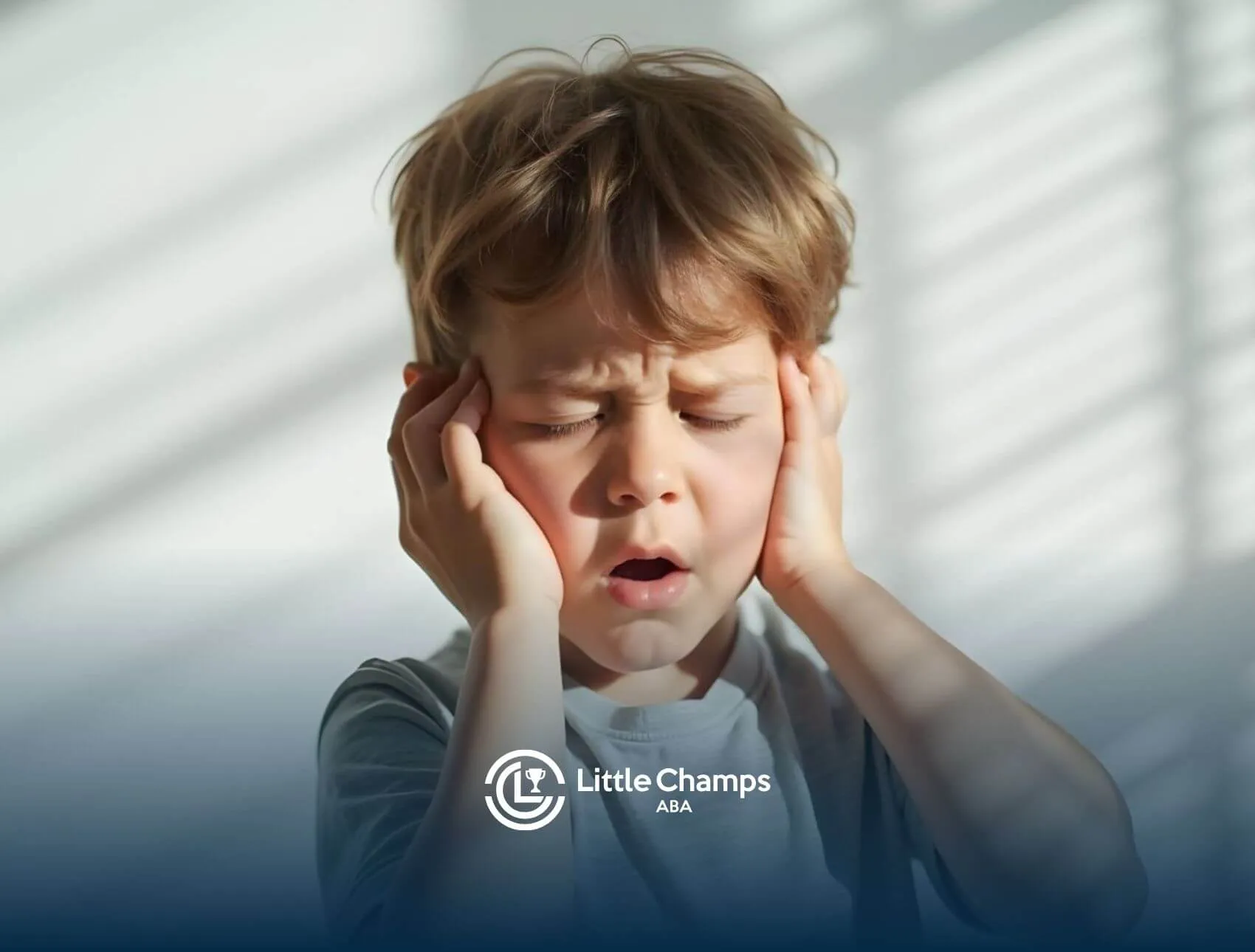
Autism noise sensitivity can transform ordinary environments into overwhelming ones.
Through our telehealth ABA services, we coached a homeschooling family whose child refused to complete lessons when multiple appliances were running. By identifying auditory triggers and building coping routines, our team at Little Champs ABA saw measurable improvement in engagement within weeks.
Experiences like these remind us: overstimulation isn’t behavioral defiance—it’s neurological overload.
Now let’s look at why that overload happens.
Understanding Autism Noise Sensitivity and Sensory Processing Differences
To understand autism noise sensitivity, we first need to understand how sensory processing works.
Sensory processing is how the nervous system receives, organizes, and responds to environmental input. For many autistic individuals, this system functions differently—especially with auditory input.
How the Brain Processes Sound in Autism Noise Sensitivity
In most brains, background noise is filtered automatically. The hum of an air conditioner fades away. A distant conversation blends into the background.
For many autistic individuals, that filtering mechanism works differently. Sounds can arrive at equal intensity, competing for attention simultaneously.
We’ve observed this frequently in our in-home ABA therapy sessions. A child working at the kitchen table may suddenly cover their ears—not because of the task—but because:
- The refrigerator turns on
- A sibling walks across the room
- A dog barks outside
Each sound layers on top of the other. Instead of fading out, they stack up.
This constant processing demand drains cognitive energy quickly.
Hyperacusis and Heightened Hearing in Autism Noise Sensitivity
Some autistic individuals experience hyperacusis—an increased sensitivity to certain sound frequencies. Even without a medical diagnosis, many children we support demonstrate:
- Lower tolerance for sharp or high-pitched noises
- Strong startle responses
- Extended recovery time after loud events
One teenager receiving our ABA therapy for teenagers in Utah described cafeteria noise as “like standing inside a speaker.” Once we introduced structured coping plans and gradual exposure techniques, his tolerance improved—but only when we respected his sensory experience first.
Why Autistic People Get Overstimulated by Noise
Overstimulation occurs when sensory input exceeds the brain’s ability to regulate it effectively.
It’s not just about loudness. It’s about intensity, unpredictability, and duration.
Sensory Filtering and Autism Noise Sensitivity
In neurotypical processing, the brain prioritizes important sounds and suppresses irrelevant ones. In autism, that prioritization may not function the same way.
Imagine trying to complete homework while:
- A microwave beeps
- A phone vibrates
- A chair scrapes
- Someone coughs nearby
Now imagine none of those sounds fade into the background.
We worked with a homeschooled learner through our telehealth ABA services whose math refusal increased daily. After careful analysis, we discovered the issue wasn’t academic difficulty—it was overlapping environmental noise during instruction time. Once we adjusted the learning environment and introduced noise-reduction strategies, task engagement increased significantly.
Filtering differences change everything.
Nervous System Activation and Autism Noise Overstimulation
Noise overstimulation often activates the autonomic nervous system—the body’s fight-or-flight response.
When this happens, we may see:
- Crying or yelling
- Covering ears
- Aggression
- Elopement
- Shutdown behaviors
At Little Champs ABA, we conduct functional behavior assessments to determine whether behaviors serve an escape function related to sensory overload.
In one daycare setting where we provided daycare-based ABA therapy, a child frequently attempted to leave circle time. Data revealed spikes in behavior precisely when group singing began. Once we adjusted proximity to speakers and taught a break-request communication response, incidents decreased dramatically.
The child wasn’t avoiding participation. They were escaping discomfort.
What Autism Noise Sensitivity Feels Like in Real Life
Autism noise sensitivity isn’t just about annoyance. Many autistic self-advocates describe sound as physically painful or disorienting.
From our clinical perspective, we’ve seen that noise sensitivity can:
- Reduce attention span
- Increase irritability
- Impact academic performance
- Limit social participation
One elementary student we supported in Colorado would appear “oppositional” during assemblies. After implementing structured accommodations through our Colorado ABA therapy services, including advanced preparation and exit strategies, we saw significant improvements in regulation and participation.
Understanding the experience changes the intervention approach.
Evidence-Based ABA Strategies for Autism Noise Sensitivity
At Little Champs ABA, we approach autism noise sensitivity through two primary pathways: environmental support and skill development.
Environmental Supports for Autism Noise Sensitivity
We often begin by modifying the environment:
- Noise-canceling headphones
- Quiet corners or recovery spaces
- Predictable warnings before loud events
- Seating adjustments
These are not crutches—they’re accommodations that allow learning to happen.
In school-based ABA therapy sessions, something as simple as moving a desk away from a hallway reduced daily dysregulation episodes.
Environment influences behavior.
Teaching Coping Skills for Autism Noise Overstimulation
Beyond environmental adjustments, we focus on building internal regulation skills.
We teach:
- Functional communication (“It’s too loud.”)
- Self-advocacy
- Visual rating scales for discomfort
- Planned sensory breaks
- Gradual exposure paired with reinforcement
For example, during in-home ABA therapy, we might:
- Introduce mild background noise during a preferred activity.
- Reinforce calm responses.
- Slowly increase intensity over time.
We never force exposure. We shape tolerance carefully and ethically.
Supporting Autism Noise Sensitivity with Little Champs ABA
Autism noise sensitivity is not something a child simply “grows out of.” But with structured, evidence-based support, individuals can build regulation skills and increase tolerance safely.
At Little Champs ABA, we provide individualized ABA therapy in both Colorado and Utah, including:
- ABA therapy at home
- ABA therapy in school
- ABA therapy in daycare
- ABA therapy for teenagers
- Telehealth ABA
We assess sensory triggers, design individualized behavior plans, and collaborate with families and schools to build meaningful, measurable progress.
If your child struggles with autism noise sensitivity, we’re here to help.
Contact us today to schedule a consultation and learn how our ABA services can support your child’s regulation, independence, and confidence.
Together, we can turn overwhelming noise into manageable environments—one step at a time.
FAQs
1. Why are autistic people sensitive to noise?
Autistic individuals often process sensory input differently. The brain may not filter background sounds effectively, causing everyday noise to feel intense or overwhelming.
2. What causes overstimulation from noise in autism?
Overstimulation happens when auditory input exceeds the brain’s ability to regulate it. Differences in sensory filtering and nervous system activation play a major role.
3. Is autism noise sensitivity the same as hyperacusis?
Not always. Some autistic individuals have hyperacusis (painful sensitivity to sound), while others experience heightened awareness without physical pain.
4. Can autism noise sensitivity improve over time?
With structured support, gradual exposure, and coping strategies, many individuals build increased tolerance and regulation skills.
5. How can parents help a child with autism who is sensitive to noise?
Helpful strategies include noise-canceling headphones, preparing for loud events, teaching self-advocacy, and working with professionals to develop regulation plans.
Sources:
- https://my.clevelandclinic.org/health/diseases/sensory-processing-disorder-spd
- https://www.autismspeaks.org/sensory-issues
- https://www.sciencedirect.com/science/article/pii/S1750946716301027
- https://www.autismparentingmagazine.com/autism-sound-sensitivity/?srsltid=AfmBOor83xk6vRtJy8WOcf3wfXSbUbU-N33zmacDUjfaTiOJSkWQuTOy
- https://dl.acm.org/doi/fullHtml/10.1145/3597638.3608413
- https://psychcentral.com/autism/autism-sound-sensitivity