


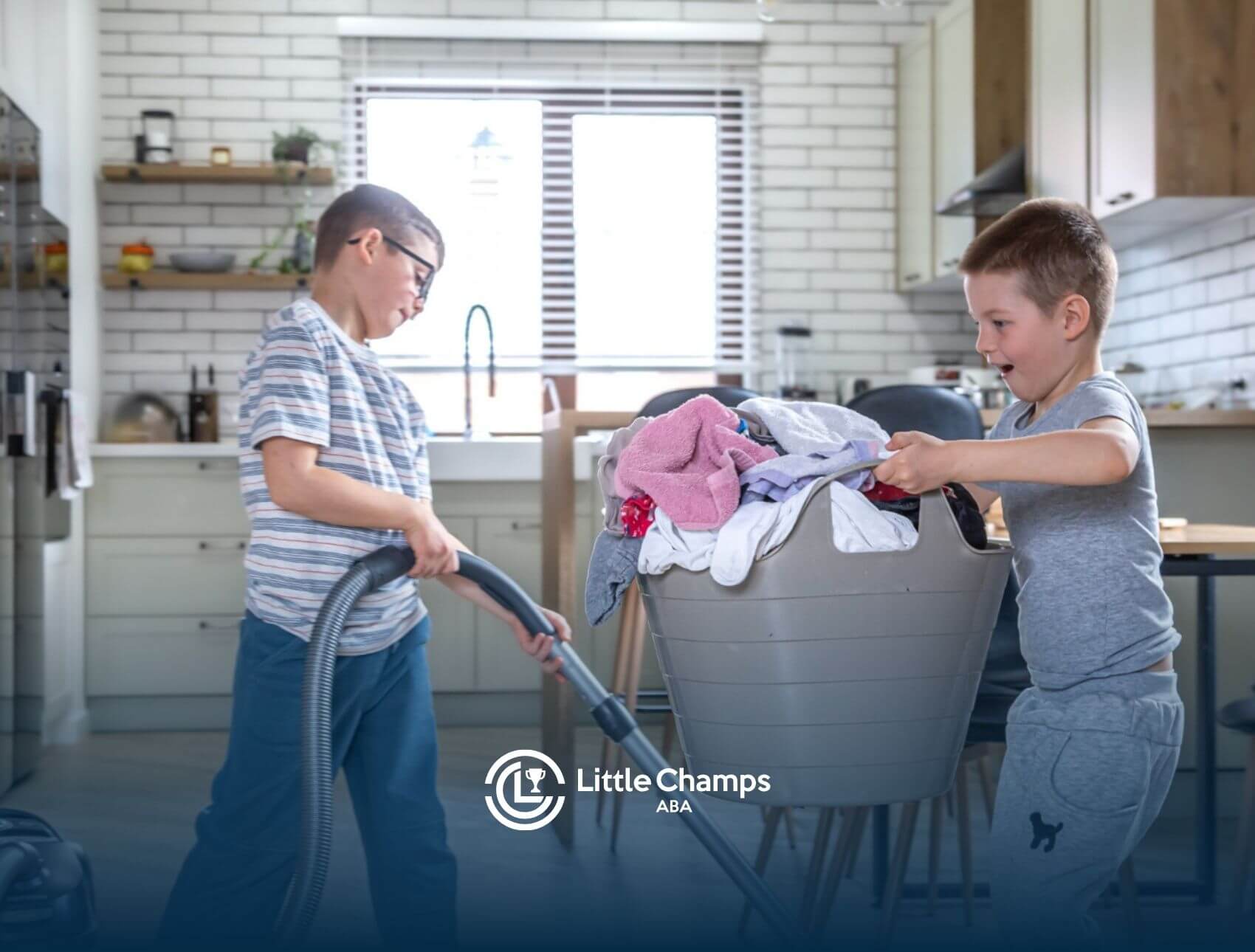
One of the most common questions Little Champs ABA’s team hear from parents is some version of: “My child can’t even make their bed—how am I supposed to get them to do chores?” And I completely understand the hesitation. Teaching a child with autism to participate in household tasks isn’t always straightforward. But it’s also one of the most meaningful things we can work on together.
Chores aren’t just about a clean house. They build independence, self-esteem, executive function, and the kind of functional life skills that matter well beyond childhood. Research consistently shows that children with autism who learn household responsibility are better prepared for adolescence and adulthood—and their families often report a meaningful increase in household cohesion.
The key is starting with the right task at the right level. Here’s what that looks like in practice.
Why Chores Build More Than Just Clean Floors
Before getting into the age-by-age breakdown, it’s worth understanding why autism-friendly chores deserve a place in your child’s routine—and your ABA programming.
Chores Build Executive Function Skills
Executive function—planning, sequencing, initiating, and monitoring tasks—is often an area of significant difficulty for autistic children. Chores provide a natural, repeatable context to practice all of these skills in a meaningful way. Doing the laundry involves sequencing (sort, wash, dry, fold). Clearing the table involves initiation and task completion.
They Support Independence and Self-Efficacy
When a child successfully completes a task that contributes to the household, something shifts. They’re no longer just the kid who needs support—they’re also someone who contributes. That shift in self-perception matters clinically and personally.
Functional Skills Generalize Better Than Isolated Drills
One of the core principles of applied behavior analysis is that skills taught in natural, functional contexts tend to generalize better. A child who sorts laundry at home is building skills that transfer to the broader world—sorting, categorizing, following multi-step instructions, sustaining attention on a non-preferred task.
How to Match Chores to Your Child’s Skill Level
Age is a useful starting point, but skill level is the more important variable. A 10-year-old with limited fine motor skills and significant executive function challenges will need different chores than a 10-year-old who’s highly capable but resistant to non-preferred tasks.
When thinking about chore readiness, consider:
- Attention span: Can they sustain focus for 2–3 minutes? 5 minutes? 10 minutes?
- Motor skills: Gross motor (sweeping, carrying) vs. fine motor (folding, buttoning)
- Instruction following: Can they follow a 1-step? 2-step? Multi-step direction?
- Initiation: Do they need a prompt to start, or can they begin independently?
- Tolerance for non-preferred tasks: What’s the emotional cost of a challenging task?
A chore that’s one step above current skill level—not five—is the right target.
Autism-Friendly Chores by Age and Skill Level
The following breakdown is a guide, not a rule. Adjust based on your child’s individual profile. Each section includes a brief table and teaching notes.
Ages 3–5: Early Participation With Maximum Support
At this stage, the goal is participation—not perfection or independence. These tasks are designed for children who follow 1–2 step directions and are building basic daily routines.
| Chore | What to Practice | Teaching Strategy |
| Put toys in a bin | Object matching, motor skills | Hand-over-hand, then fade |
| Place dishes in the sink | Following a direction, routine | Model + visual cue |
| Feed the pet (with setup) | Cause-effect, routine | First-then board |
| Wipe up spills with a cloth | Motor + instruction follow | Least-to-most prompting |
| Help sort laundry by color | Matching, categorization | Color-coded bins |
Key principle: Chores at this age should feel like play when possible. Pair with preferred music, a timer, or a high-five routine at completion.
Ages 6–9: Building Routines With Partial Independence
Children in this range can typically sustain attention for longer and follow multi-step directions with support. The focus shifts to building routine-based independence—completing a task predictably with decreasing prompts.
| Chore | What to Practice | Teaching Strategy |
| Set the table | Sequencing, spatial placement | Visual placement mat |
| Unload the dishwasher (safe items) | Categorization, routine | Visual schedule |
| Make their bed (simplified) | Multi-step, motor | Photo task analysis |
| Vacuum a small area | Sustained task, motor | Timer + video model |
| Take out trash (with guidance) | Routine, strength | Backward chaining |
| Water a plant | Routine, measurement | Visual mark on watering can |
A visual task analysis—photos of each step posted near the task—can dramatically reduce the need for verbal prompting and support true independence.
Ages 10–13: Expanding Responsibility With Meaning
Preteens with autism can handle chores with more complexity and real household significance. The emotional motivation shifts too—many children this age respond well to contributing to the family as a reason for the task, not just reinforcement.
| Chore | What to Practice | Teaching Strategy |
| Fold and put away laundry | Sequencing, categorization | Task analysis + fading |
| Wipe counters and stovetop | Attention to detail, routine | Checklist |
| Prepare simple meals/snacks | Multi-step, safety, motor | Recipe visuals |
| Sweep or mop a room | Sustained effort, quality | Video model + review |
| Pack school bag independently | Executive function, planning | Visual checklist |
| Clean their bathroom sink/toilet | Hygiene, routine, motor | Step-by-step photo guide |
Ages 14+: Functional Independence Skills
For teenagers with autism, chores become functional life skills. The lens shifts toward what they’ll need to manage independently in the future—whether in their family home, supported living, or independently.
| Chore | What to Practice | Teaching Strategy |
| Do a full load of laundry | Multi-step, machine use | Written + visual steps |
| Cook a basic meal | Planning, safety, sequencing | Recipe cards + supervised practice |
| Grocery list and basic shopping | Planning, money, social | Structured community trips |
| Manage their bedroom independently | Self-initiation, standards | Weekly checklist + self-eval |
| Pay a bill or manage allowance | Math, planning, money | Real-world practice with support |
| Clean a full bathroom | Detail, routine, hygiene | Timer + quality checklist |
ABA therapy for teenagers can directly target these functional independence goals with systematic instruction. Our ABA therapy for teenagers program at Little Champs is specifically designed for this stage.
ABA Teaching Strategies That Make Chores Stick
Picking the right chore is step one. Teaching it effectively is step two. Here are the evidence-based ABA strategies we use most frequently:
Task Analysis
Break the chore into every single discrete step. “Do the dishes” becomes: rinse plate, open dishwasher, place plate in bottom rack, close dishwasher. Each step is taught, assessed, and prompted individually until the whole chain is mastered.
Forward and Backward Chaining
Forward chaining teaches the first step first, adding steps as each is mastered. Backward chaining teaches the last step first—the child always finishes the task themselves, which provides built-in reinforcement at task completion. Both approaches are effective; the choice depends on the child and the task.
Visual Supports
Printed photo sequences, laminated checklists, and visual timers reduce the need for verbal prompting and support independence. A child who can reference a visual task analysis doesn’t need a parent nearby—which is exactly the point.
Reinforcement That’s Meaningful
Praise alone is often not sufficient. Think about what genuinely motivates your child—screen time, a preferred activity, a specific snack, social praise from a valued person—and tie it to task completion in a predictable way. Over time, the routine itself can become reinforcing.
How Little Champs ABA Can Help With Life Skills
Chore-based instruction and functional life skills development are core components of comprehensive ABA programming. At Little Champs ABA, our BCBAs work with families in Colorado and Utah to build individualized plans that target the skills your child needs most.
Our services include:
- Center-Based ABA Therapy — Skill-building in a structured clinical environment
- In-Home ABA Therapy — Teach chores and routines in your actual home environment
- School-Based ABA Therapy — Generalize skills across settings
- Daycare ABA Therapy — Support during childcare hours
- ABA Therapy for Teenagers — Independence and life skills for older learners
- Telehealth ABA — Flexible support from home
If you need support building a structured plan for chores and functional skills, our team is here to help you design it.
Reach out to Little Champs ABA today!
Frequently Asked Questions
My child refuses all chores. Where do I start?
Start with the task least likely to produce resistance—ideally something already adjacent to what they enjoy or something with immediate payoff. A child who loves order might enjoy putting things back where they belong. Build a positive association before adding challenge.
How do I handle meltdowns when introducing a new chore?
If a new chore consistently produces significant emotional responses, the task may be above the current skill or tolerance threshold. Step back, simplify, and rebuild. Pairing the new chore with high-value reinforcement during initial teaching phases is essential.
Should chores be on a visual schedule?
Yes—especially for children who benefit from predictability. A visual schedule that shows chore time as a regular, expected part of the day reduces resistance significantly. Surprise requests feel very different from expected routine.
How many chores should my autistic child be doing?
There’s no universal number. Start with one task done consistently and well before adding another. Building mastery and positive associations matters more than volume. A child who genuinely owns two chores is far more valuable than a child who partially does five.
Can ABA therapy target household chores specifically?
Yes. In-home ABA services are particularly well-suited for this. Our clinicians can work directly in your home environment, teaching chores using the actual materials and spaces your child will use. Connect with Little Champs ABA to explore what this looks like for your child.
Sources:
https://childmind.org/article/autism-and-puberty/
https://www.kennedykrieger.org/stories/interactive-autism-network-ian/autism_in_teens
https://www.autismparentingmagazine.com/motivate-autistic-child-do-chores/