


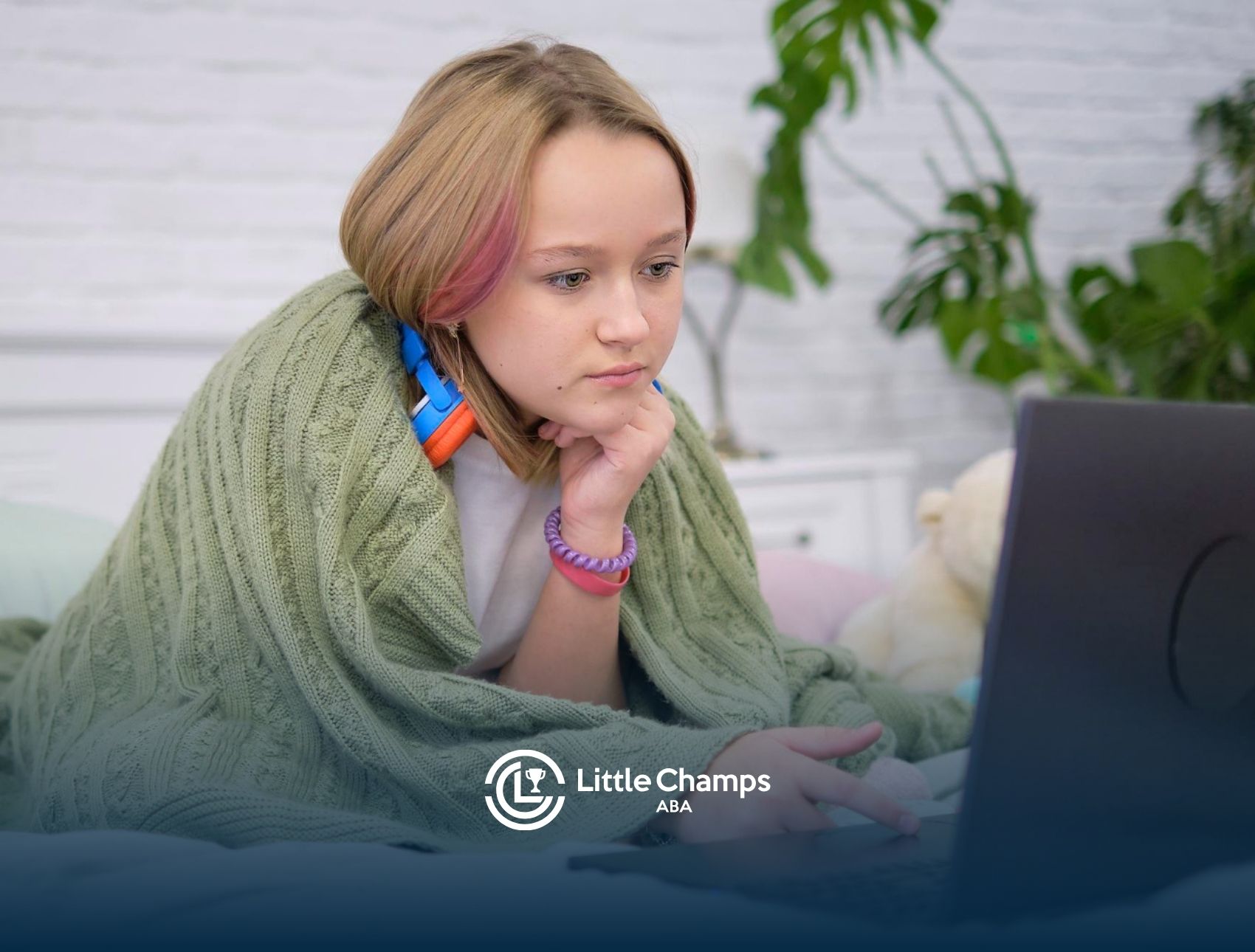
Most stranger danger lessons were built around a single scenario: a stranger, a car, a park. That scenario almost never matches how risk actually shows up for autistic tweens and teens today, which is far more likely to look like a slow-building online relationship than an obvious threat.
At Little Champs ABA, I see the same gap in how families think about handling bullying: the harm rarely looks the way people expect, so it goes unnoticed longer than it should. Real online safety for autistic tweens and teens needs rules built for how risk actually shows up, not how it used to.
Why the Old Stranger Danger Rules Often Fall Short
Most of us grew up with a single, blunt rule: do not talk to strangers. That rule was never very precise, and for a lot of autistic kids it breaks down even further once real life gets more complicated than a stranger standing next to a swing set.
Literal Thinking and Absolute Rules
A rule like “don’t talk to strangers” assumes a child can instantly sort every new person into “stranger” or “not stranger,” and then apply that label consistently across a classroom, a bus stop, and a group chat. Many autistic kids think in very literal, rule-based ways, which is a strength when the rule is clear and a real vulnerability when it is not. A new online friend who has “known” your child for six months through a shared game does not feel like a stranger anymore, even though the label technically still applies.
The Pull Toward Connection Online
Plenty of autistic tweens and teens tell me the internet feels easier than in-person friendship. There is no eye contact required, conversations can be typed out and thought through, and shared interests are easy to find. That is genuinely valuable, and I do not want to talk anyone out of it. It also means an autistic teen may be more motivated to keep a connection going, even after warning signs appear, because that connection can feel rarer and harder-won than it would for a peer who makes friends easily offline.
Building Safety Judgment Instead of Memorized Rules
Rules that only work in one specific scenario tend to fall apart the moment real life looks slightly different. The goal is to build judgment your child can apply flexibly, not a script they recite once and forget.
Teaching Categories, Not Just “Strangers”
Instead of one blanket rule, we work with families to build out categories: people your child has met in person and knows well, people who are online-only but verified by a parent, and people who are online-only and unverified. Each category comes with its own specific rules about what information can be shared and what requires a parent’s involvement first. This is far more concrete than “use good judgment,” a phrase that means almost nothing to a lot of autistic kids.
Practicing Scripts for Common Situations
Role-play matters here more than almost anywhere else. Practicing exactly what to say when someone online asks for a phone number, a photo, or a meetup, and rehearsing it enough times that the response becomes close to automatic, builds a kind of safety net that a single conversation never will.
Online Risks That Autistic Tweens and Teens Face More Often
Research consistently points to a higher risk of certain online harms among autistic adolescents compared with their non-autistic peers, and understanding why can help families focus their efforts where they matter most.
Vulnerability to Manipulation Online
Difficulty reading intentions, a strong desire for social connection, and a tendency to take statements at face value can combine to make some autistic tweens and teens more susceptible to online manipulation. This does not mean every autistic child is at equal risk, and it is not a reason for shame if something has already gone wrong. It is a reason to build specific, practiced skills for recognizing pressure, secrecy requests, and requests that escalate over time.
Oversharing on Games and in Group Chats
A lot of risk shows up in ordinary places: gaming platforms, group chats, and comment sections, rather than obviously dangerous corners of the internet. Autistic teens who enjoy detailed, rule-based games sometimes trust the platform itself, assuming that if a game allows a certain kind of chat, that chat must be safe. Reviewing privacy settings together and talking through the specific platforms your child actually uses matters more than one generic conversation about “the internet.”
Creating a Family Online Safety Plan
A plan that lives only in conversation tends to get forgotten under stress. Writing it down, and revisiting it regularly, works better for most of the families we support.
Concrete, Written Boundaries
Specific rules, like which apps require a parent to know the password, what information never gets shared no matter how well someone seems to be known, and what happens if a stranger reaches out, give your child something to refer back to instead of guessing in the moment.
Staying in the Loop Without Constant Surveillance
Full monitoring of every message can feel protective, but it also risks pushing communication further underground if a teen feels watched rather than supported. A better long-term approach usually blends some monitoring with a standing, judgment-free promise: telling a parent about something confusing or uncomfortable online will never result in the phone being taken away as a punishment. If your family is also navigating peer conflict or handling bullying, many of the same open-communication strategies apply.
How ABA Therapy Builds the Skills Behind Online Safety
A lot of what protects a child online is not really about technology at all. It is about the underlying skills: recognizing manipulation, tolerating an uncomfortable no, and asking for help before a situation escalates.
If your family wants extra support building these skills, this is exactly the kind of work we do at Little Champs ABA. We provide ABA therapy across Georgia, Colorado, and Utah in whatever setting fits your family best:
- Center-based ABA therapy
- ABA therapy at home
- ABA therapy in school
- ABA therapy in daycare
- ABA therapy for teenagers
- Telehealth ABA
Safety skills tend to build on top of skills your teen is already working on, like self-advocacy and navigating the broader challenges of adolescence. The more practiced your teen is at recognizing pressure and asking for help offline, the more that skill tends to carry over into their online life as well.
If you are curious whether ABA therapy could help your family build these safety skills, reach out to our team. We would love to talk through what your child needs and build a plan around it.
Frequently Asked Questions
At what age should we start talking about online safety with an autistic child?
Many families start as soon as a child has any independent access to a device, often around age eight or nine, and then keep the conversation going in age-appropriate ways as independence grows. Earlier, simpler conversations tend to work better than one big talk later on.
How do I bring this up without scaring my child?
Keep the focus on building a skill rather than warning about danger. Framing it as practicing what to say, similar to practicing what to do during a fire drill, tends to feel calmer and more concrete than a conversation centered on fear.
What if my teen already talks to people online that I do not know?
Start where you are. Rather than removing access all at once, which often backfires, work together to sort existing contacts into categories and build a plan for verifying anyone new going forward.
Should I use parental monitoring apps?
Monitoring tools can be one part of a safety plan, but they work best paired with open conversation rather than used as a replacement for it. A teen who feels only surveilled, without also feeling supported, is more likely to hide activity rather than share it.
What are some warning signs that a situation online has become unsafe?
Watch for a child becoming secretive about a specific person or app, receiving gifts or money from someone they only know online, or showing sudden changes in mood after using a device. If you notice these signs, involve a trusted adult or professional rather than managing it alone.
Sources:
- Wright, M. F. (2018). Cyber Victimization and Depression among Adolescents with Autism Spectrum Disorder: The Buffering Effects of Parental Mediation and Social Support. Journal of Child & Adolescent Trauma, 11(1), 17–25. https://pmc.ncbi.nlm.nih.gov/articles/PMC7158962/
- Prevalence of Victimisation in Autistic Individuals: A Systematic Review and Meta-Analysis. Trauma, Violence, & Abuse (NIH/PMC). https://pmc.ncbi.nlm.nih.gov/articles/PMC10486169/
- Online social media poses opportunities and risks in autistic youth: implications for services. Frontiers in Psychiatry (NIH/PMC). https://pmc.ncbi.nlm.nih.gov/pmc/articles/PMC10348421/
- StopBullying.gov (U.S. Dept. of Health and Human Services). Bullying and Youth with Disabilities and Special Health Needs. https://www.stopbullying.gov/bullying/special-needs
- StopBullying.gov (U.S. Dept. of Health and Human Services). Digital Awareness for Parents. https://www.stopbullying.gov/cyberbullying/digital-awareness-for-parents
- Federal Bureau of Investigation. Information for Parents, Caregivers, and Teachers. https://www.fbi.gov/how-we-can-help-you/parents-and-caregivers-protecting-your-kids
- U.S. Department of Homeland Security. Know2Protect. https://www.dhs.gov/know2protect
- National Center for Missing & Exploited Children. NetSmartz. https://www.missingkids.org/netsmartz/home
- National Center for Missing & Exploited Children. Sextortion. https://www.ncmec.org/theissues/sextortion
- Organization for Autism Research. Life Journey Through Autism: A Guide to Safety. https://researchautism.org/wp-content/uploads/2016/03/A_Guide_to_Safety.pdf