


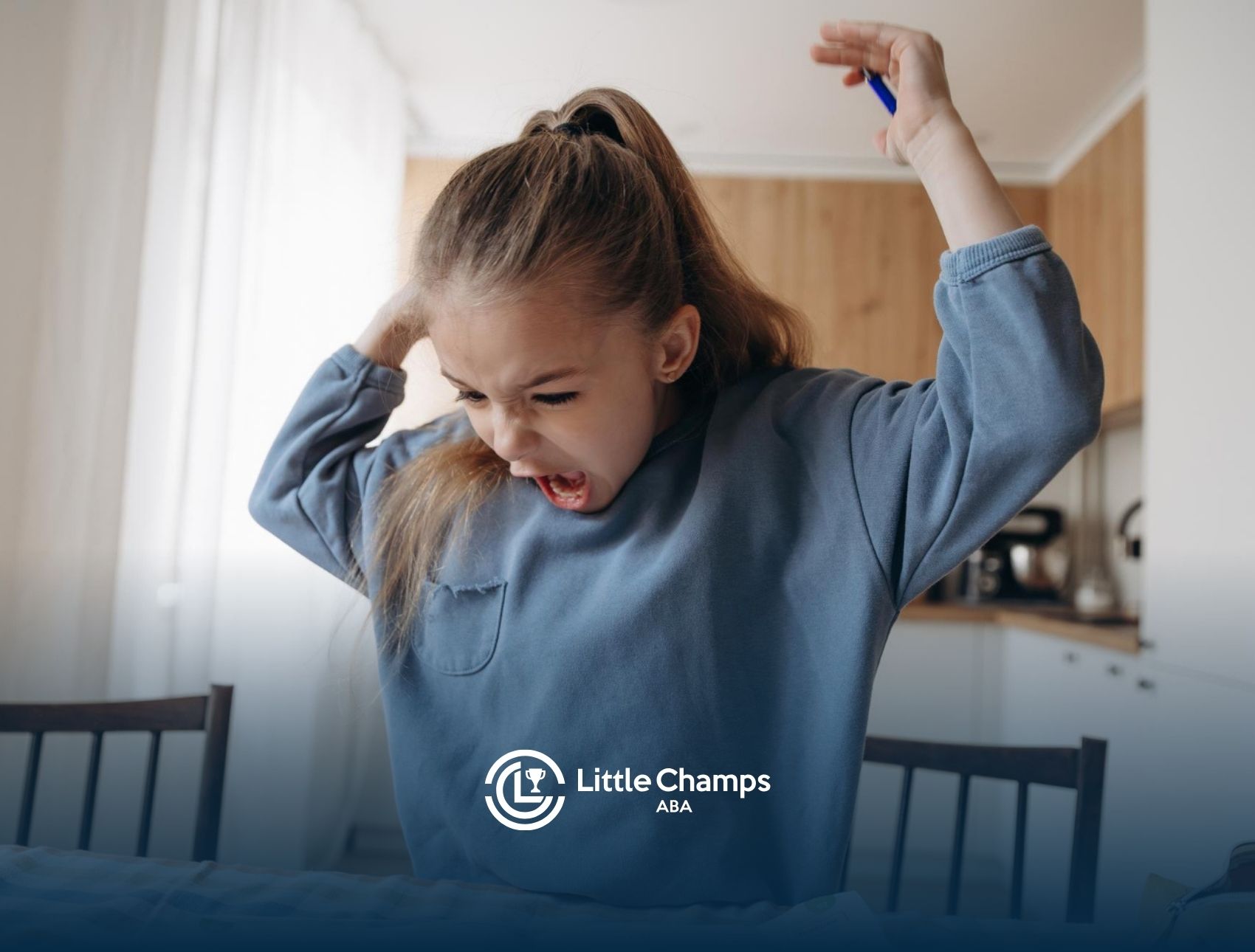
Most throwing comes down to one of four reasons: ending a demand, getting a fast reaction, reaching a preferred item, or the sensory feedback of the throw itself. For a child still building language, throwing is often the quickest message available.
The shape of the behavior tells you very little on its own. Two children can throw the same cup for completely different reasons, and the plans that help them look nothing alike.
Figuring out which reason applies is where our BCBAs at Little Champs ABA start, and it’s work you can begin at home this week.
The Four Reasons Behind Throwing Objects
Behavior analysts group the reasons for any behavior into four functions. Throwing can serve any of them, and some children switch between two depending on the setting. The IRIS Center at Vanderbilt University offers a free walkthrough of how these functions are identified.
Escaping a Demand or Transition
The homework folder comes out and the pencil goes flying. If throwing consistently happens when something is being asked of your child, and the task stops afterward, escape is the likely driver.
Getting a Fast Reaction
Some children learn that a thrown object brings an adult across the room in about two seconds. Look for throwing that happens when you’re on the phone, with a sibling, or otherwise occupied.
Reaching a Preferred Item
A child who wants the tablet back may throw whatever is in reach until someone figures out what they want. Throwing here is a request that hasn’t found better words yet.
Sensory Feedback From the Motion
Some throwing has nothing to do with people. The arc, the crash, the way a ball bounces off a wall can be reinforcing all by itself. This type tends to happen alone, during downtime, with the same kinds of objects each time.
How to Identify Which Reason Fits Your Child
A week or two of simple notes usually reveals the pattern. No formal data system needed.
Jot down five things each time it happens:
- The time of day
- What was happening right before
- What your child threw
- What you or others did next
- How long it took to settle
Patterns show up quickly. If most entries share the same “before,” you’re looking at a trigger. If they share the same “after,” you’re looking at what keeps it going. Our post on challenging behaviors covers how a BCBA turns those notes into a formal assessment.
One family I worked with was convinced their son threw toys out of frustration with his sister. Two weeks of notes showed almost every incident happened right before bath time.
What to Do in the Moment
During the event, aim for safety and a calm ending. Teaching happens later, once everyone is regulated.
- Move nearby hard or breakable objects out of reach without a lecture.
- Keep your words few and your voice low. Long explanations give attention and rarely land.
- Guide your child to a safer spot if objects are still flying.
- Wait for calm before talking about what happened.
- If the task caused it, return to it briefly once your child is settled, so the throw doesn’t end the demand entirely.
When the episode is sensory overload rather than a goal-directed behavior, the response shifts toward lowering demands and giving space. Our guides to tantrums and meltdowns and after-school meltdowns break down that difference in detail.
Teaching a Faster Way to Communicate
Throwing fades most reliably when something easier replaces it. In practice, that means giving your child a way to get the same result with less effort.
Functional communication training is the approach with the strongest research support here. AFIRM at the University of North Carolina summarizes the evidence base and the teaching steps.
What that looks like at home:
- Teach one clear request first, such as “break,” “help,” or “all done,” using speech, a sign, a picture card, or a device.
- Honor that request immediately at the start, even if the timing is inconvenient. Speed is what makes the new skill compete with throwing.
- Build waiting tolerance gradually once the request is solid.
- Offer a safe place where throwing is allowed, like beanbags into a laundry basket, so the sensory version has an outlet.
Progress usually shows up as fewer incidents and quicker recovery rather than a clean stop. That’s a normal trajectory, not a sign the plan is failing.
Changes at Home That Lower the Odds
Prevention does more work than any in-the-moment strategy. Small environmental changes reduce how often your child reaches that point.
- Give transition warnings with a timer or visual schedule.
- Use a first-then format for non-preferred tasks.
- Keep hard objects out of the two or three spots where throwing happens most.
- Schedule demanding tasks away from the hungry, tired parts of the day.
- Rule out pain, illness, or poor sleep when throwing spikes suddenly. The National Institute of Child Health and Human Development notes that treatment should target a child’s specific needs rather than the diagnostic label, and discomfort is a frequent hidden driver.
When to Bring in Your Child’s Team
Some throwing is ordinary and passes with consistency at home. Other patterns call for a professional assessment.
Reach out to a BCBA or your pediatrician if throwing happens most days, results in injury or property damage, appears suddenly after a calm stretch, or has started affecting school placement or child care.
Our team assesses these patterns every week across Colorado, Utah, Georgia, and Virginia, including families in Denver and Atlanta. Because throwing often shows up in one setting more than another, we work wherever the pattern lives:
- Center-based ABA therapy
- ABA therapy at home
- ABA therapy in school
- ABA therapy in daycare
- ABA therapy for teenagers
- Telehealth ABA
If you’re weighing whether therapy is the right step, who qualifies for ABA walks through eligibility.
Moving From Reacting to Teaching
When an autistic child throws things, the behavior is carrying a message that words haven’t caught up to yet. Track the pattern, respond calmly, and teach a faster way to send the same message.
Progress tends to be uneven, and that’s expected. If you want a BCBA’s read on what’s driving the throwing in your home, reach out to our team or start the intake process. You can also read more about the benefits of ABA before you decide.
Frequently Asked Questions About Throwing Behavior
Is throwing a sign of aggression?
Not usually. Most throwing is a request or an escape attempt rather than an attempt to hurt anyone, though objects aimed at people need a safety plan either way.
Should I ignore it?
Only when attention is the confirmed reason, and even then, ignoring alone rarely works. Pair it with teaching a faster way to get your attention.
Will punishment stop the throwing?
It may suppress it briefly, but it doesn’t teach a replacement, and the behavior tends to return or shift to another form.
Does throwing mean ABA isn’t working?
No. Behaviors often continue for a while as new skills are being taught, and some briefly increase before they decline.
Sources:
- Autism Focused Intervention Resources and Modules. (2025). Functional communication training. University of North Carolina at Chapel Hill. https://afirm.fpg.unc.edu/module/functional-communication-training/
- Eunice Kennedy Shriver National Institute of Child Health and Human Development. (n.d.). What are the treatments for autism? https://www.nichd.nih.gov/health/topics/autism/conditioninfo/treatments
- IRIS Center. (n.d.). Functional behavioral assessment (elementary): Identifying the reasons for student behavior. Vanderbilt University. https://iris.peabody.vanderbilt.edu/module/fba-elem/
- IRIS Center. (n.d.). Hypothesis statements. Vanderbilt University. https://iris.peabody.vanderbilt.edu/module/fba-elem/cresource/q2/p07/
- Centers for Disease Control and Prevention. (2026). About autism spectrum disorder. https://www.cdc.gov/autism/about/index.html
- Centers for Disease Control and Prevention. (2025). Accessing services for autism spectrum disorder. https://www.cdc.gov/autism/treatment/accessing-services.html