


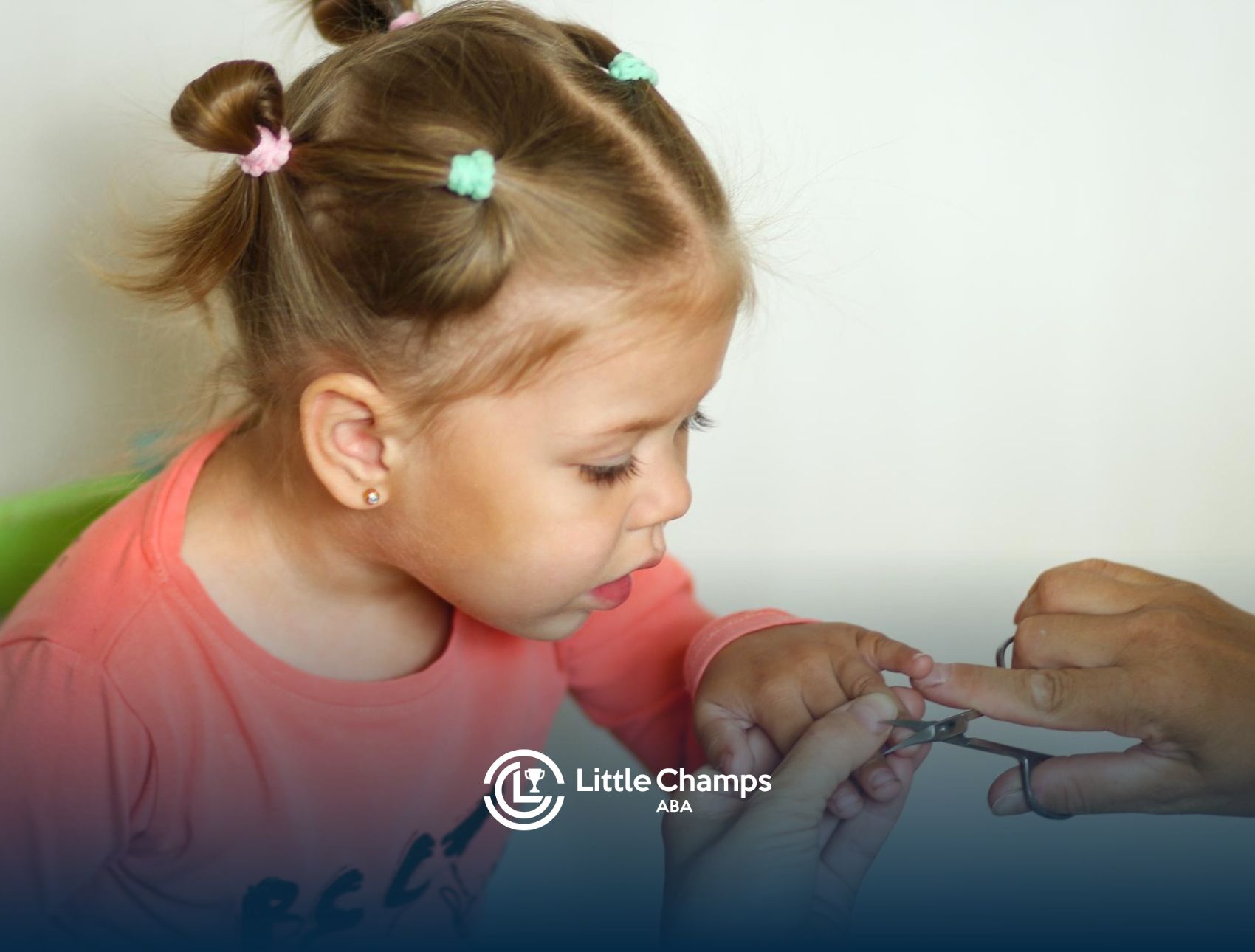
The clippers come out, and your child’s whole body changes. Shoulders lift, hands tuck under arms, and a quiet evening becomes a standoff. Autism nail cutting is one of the most common daily-living struggles families bring to Little Champs ABA, and it responds well to preparation, patience, and a clear plan.
With about 1 in 31 eight-year-olds identified with autism in CDC surveillance data, many households are having this same evening. The approach that helps most is to ready the body first, make the routine visible, and teach the skill in steps small enough for your child to say yes to. Everything below draws on what I see work in homes and on the research behind it, so you can start with one idea tonight and build from there.
Why Autism Nail Cutting Triggers Such Big Reactions
Unusual responses to touch, sound, and pain are part of how autism is defined, and the CDC’s diagnostic criteria name them directly. Nail care stacks several of those triggers into one short task, which is why a few seconds of trimming can produce a huge response.
The Sensory Load of a Single Snip
A clipper presses on a sensitive fingertip, clicks loudly, and sends a small vibration through the nail. Some children feel that as pinching or pulling. Others dislike having a finger held and moved, or the sight of a sharp tool near their skin.
Each piece may be tolerable alone. Together, in a few seconds and without warning, they can overwhelm a child’s ability to cope.
Pain, Pressure, and Body Signals
Children differ widely in how they sense discomfort. Some have a lower pain response and cannot tell why a grown-up is gripping their hand so firmly. Others feel pressure intensely and brace before the clippers even touch.
Differences in reading internal body signals can add to the confusion. Our post on interoception in autism explains how this works and why it affects everyday routines.
The Problem of Not Knowing What Comes Next
Children also remember. One nicked finger or one rushed session can teach a child that clippers predict discomfort. Many cannot tell how long the task will last, so every nail could be the final one or the first of ten.
I supported one first-grader who left the room the moment the nail kit appeared. When we laid out five picture cards on a strip and let him remove one after each nail, he stayed for the first time. The clippers were the same. The difference was that he could finally see where the task ended.
How Avoidance Grows Over Time
Here is a pattern I see often. A child protests, the grown-up stops, and the child learns that protesting ends the session. Nobody did anything wrong. The child found a strategy that works, and behavior analysts call this escape-maintained behavior.
It explains why a nail routine can get harder the longer it goes unaddressed. Understanding the purpose behind a behavior is the foundation of a behavior assessment, and our post on how a functional analysis differs from an FBA shows how clinicians figure it out.
Preparing Your Child Before the Clippers Come Out
Preparation does more work than persuasion. A few minutes of setup often decides how the next ten minutes go, and most of it costs nothing.
Pick the Right Moment
Avoid times when your child is hungry, sleepy, or already stretched thin. A calm weekend morning usually beats a weekday evening. Right after a bath is a good window because softened nails need less pressure.
Skip the after-school hour. Many children arrive home depleted, and our guide to after-school meltdowns explains why that stretch is so fragile.
Build a Predictable Routine
Choose one place, one time of day, and one order of events. Use the same chair, the same lighting, and the same words each time. Children relax when they know what to expect, and sameness is one of the most useful things you can offer.
Show the sequence with a First/Then card, a picture strip, or a visual timer. Visual supports are a documented evidence-based practice in the University of North Carolina’s AFIRM project, and they work because they replace unclear verbal reminders with something your child can see.
Warm Up Hands and Feet
Firm pressure calms many children. Offer hand squeezes, a lotion massage, a game of pressing palms together, or a vibrating toy before you start. Add a fidget or a favorite show to hold attention.
Feet are often more sensitive than hands, so give toes their own, later schedule. Occupational therapy, which the CDC describes as building daily skills such as dressing and bathing, can tailor sensory input to your child, and ABA and OT goals often fit together well.
Choose Tools That Reduce Surprise
The right tool depends on which part of the experience bothers your child most. A few options worth testing:
- Nail file or emery board: removes the click and the pinch, and lets you shorten nails gradually.
- Battery-powered file: quick and quiet for some children, though the vibration bothers others.
- Quiet clippers with a soft grip: reduce noise and hand strain.
- Rounded safety scissors: give more visual control for small hands and young children.
Offer two options and let your child choose. Choice moves the task from something done to your child toward something done with them.
Set Up the Space and Body Position
Gather everything before you begin so you never have to stop mid-task. Dim harsh lights and turn off competing noise, or offer headphones if sound is the issue. A supported seat, a lap cushion, or a weighted lap pad helps some children stay settled.
Let your child hold the tool or place their hand over yours for part of the step. That shared control reduces the feeling of being held in place.
A Step-by-Step ABA Plan for Nail Trimming at Home
ABA breaks a hard skill into small steps, called a task analysis, and reinforces each one so cooperation leads somewhere good. Progress follows your child’s comfort, never a calendar.
Build a Ladder of Small Steps
Here is a sample ladder. Spend as many days on each rung as your child needs.
- Look at the file or clippers from across the table.
- Touch the tool to a toy, then to your own nail.
- Touch the tool to your child’s hand if they agree.
- Hold one finger gently for three seconds.
- Rest the tool on one nail without cutting.
- Make one snip or one file stroke.
- Finish one nail, then two, then a full hand.
- Add the second hand, then toes on a separate schedule.
Move up only after your child stays relaxed across several tries. If distress rises, step back one rung without comment. Clinicians call this gradual exposure paired with reinforcement, and stepping back is a normal part of it.
Pair the Tools With Good Things
Before any trimming, let the kit become a neutral or pleasant object. Leave a file in a sensory bin, let your child explore the clippers during play, and hand over a snack or a game right after each look or touch. There is no demand attached at this stage.
Clinicians call this pairing. A child who has seen a tool alongside fun, with no pressure, often approaches it with less dread when the real task begins.
Reinforce Effort Right Away
Give a preferred item or activity immediately after each completed step, small and quick. Praise works for some children, while others prefer a short game, a sticker, or a favorite toy for thirty seconds. Choose rewards your child already wants.
Reinforce the effort as well as the finished nail. A child who tolerated one extra second of contact has earned a reward, and that signal teaches them that trying pays off.
Teach and Honor a Stop Signal
Teach a clear way to ask for a break, such as a stop card or hand signal, and respond to it every time. This is called functional communication training, and it replaces screaming or escaping with a skill that works.
Children who learn that stop is respected often use it less and tolerate more. I advise families never to hold a child down to finish, because it erodes the trust the whole plan depends on.
Phrase Requests So They Feel Safe
Direct commands can raise the pressure for children who are sensitive to demands. A softer opening, such as “I wonder if our fingers are ready for a nail spa,” can lower it. Our post on declarative language offers dozens of ways to phrase a request.
Practice Outside the Moment
Rehearsal away from the real task lowers the stakes. Trim a doll’s nails together, let your child watch a sibling or parent go first, or read a short social story about nail care with photos of your own routine.
AFIRM lists task analysis, social narratives, and video modeling among its evidence-based practice modules, and all three adapt well to nail care. A short video of a child your child’s age trimming nails calmly can also make the task feel ordinary.
A Sample Two-Week Starter Plan
Treat this as a template, since many children need longer on early steps.
- Days 1–3: Explore the kit during play with no demands, and reward any approach.
- Days 4–6: Add a hand massage, then touch the file to the nail for one second.
- Days 7–9: File one nail briefly, then stop and reward.
- Days 10–14: File or trim one to two nails daily at the same time and place.
Track Progress Simply
Keep a small log with the date, the step you reached, a distress rating from 1 to 5, and what helped. After a week you will see patterns, such as which tool, time of day, or distraction works best.
Share the log with your child’s clinical team. Clear notes make it far easier to adjust the plan.
When Nail Cutting Stalls
Progress rarely moves in a straight line, and a stalled plan usually means a step needs shrinking. These are the sticking points I see most.
If Your Child Escalates Mid-Step
Pause, lower your voice, and return to the last step your child handled calmly. End the session on a success, even if that success is one touched finger. Finishing on a win keeps tomorrow’s attempt from starting with dread.
If Toes Are the Hard Part
Feet are usually more sensitive, and some children tolerate socks only. Work on toes after hands are going well. Try a warm foot soak, a firm foot massage, and a reclined position, and trim one toe at a time.
If Nail Biting or Picking Is Involved
Keep nails short and smooth so there is less to bite or pick. Mention it to your pediatrician if the skin is breaking, and avoid scolding. An ABA clinician can look at when biting or picking happens and what it seems to do for your child, then teach a replacement.
If Different Caregivers Do It Differently
Children do best when routines match across adults. Share your visual strip, scripts, and reinforcement with the other parent, grandparents, and anyone else who helps. A child may accept nail care from one person and resist it from another, and a shared routine closes that gap.
Older Children, Independence, and When to Ask for Help
Needs change as children grow, and some situations call for another set of eyes. Planning for independence early makes the later years smoother.
Building Independence as Children Grow
Many older children can learn to trim their own nails with a checklist and a mirror. Write the steps in order, cover wash, dry, trim, file, and clean up, and fade your help gradually. Puberty brings extra grooming tasks, and our guide to puberty and autism covers the wider routine.
Signs It Is Time to Check In
Talk with your pediatrician, a podiatrist, or an occupational therapist if you notice ingrown nails, redness or swelling, nail biting that breaks the skin, or pain your child cannot describe. Distress that spreads to haircuts, tooth brushing, or hair washing also deserves a conversation with your child’s team.
Nail Care Support From Little Champs ABA
Grooming goals fit naturally inside a treatment plan, and our team builds them around your family’s routines. Our BCBAs can observe the routine, break it into steps, and coach you through each one. We offer:
- Center-based ABA therapy
- ABA therapy at home
- ABA therapy in school
- ABA therapy in daycare
- ABA therapy for teenagers
- Telehealth ABA
Families reach us across four states. In Colorado, we serve communities such as Denver and Aurora, and our Colorado ABA therapy page shows everything available.
Utah families can visit our Cottonwood Heights or Park City center, or connect with us in Salt Lake City. In Georgia, you will find us in Atlanta and Alpharetta, and our Virginia ABA therapy page covers care there.
Calmer Autism Nail Cutting Starts With One Small Step
Autism nail cutting gets easier when your child’s body is ready, the routine is visible, and they control some of the pace. Choose one idea from this post, try it for a week, and jot down what your child tolerates. Those notes help any clinician working with you, and they reveal progress that is easy to miss day to day.
Progress here is measured in single nails, and each one counts. Questions about your own routine? Call our team at 385-494-3500 and we will talk it through.
Frequently Asked Questions About Autism Nail Cutting
Why does my autistic child scream during nail trimming?
Often it is a mix of touch sensitivity, the click of the clippers, and uncertainty about how long it will last. A past nick can add fear. Identifying which piece bothers your child most points you toward the right fix.
Is a nail file better than clippers?
For many children, yes, because a file removes the pinch and the sound. Others dislike the scraping texture or vibration, so test both and let your child choose.
Should I cut nails while my child sleeps?
Some families do this as a short-term safety measure. It does not teach the skill, and a child who wakes mid-trim may become more wary. Discuss it with your child’s care team and keep working on daytime routines.
Why does my child let someone else cut their nails but not me?
Children respond differently to different people, settings, and routines. Another adult may move more slowly, hold differently, or carry less history of past struggles. Ask what that person does, copy the useful parts, and use the same visuals and language across caregivers.
How long until nail cutting gets easier?
There is no reliable timeline. Some children improve within a few weeks, while others need months of small steps. Progress depends on your child’s sensory profile, history, and how consistently the routine is practiced.
When can my child learn to cut their own nails?
Many children begin practicing fine-motor and checklist steps in the elementary years, often starting with filing, and readiness depends on motor skills, safety awareness, and attention. A BCBA or occupational therapist can help you judge when to begin and how much support to build in.
Can ABA therapy help with nail cutting?
Yes, as part of a broader daily-living skills plan. A BCBA can analyze what makes nail care hard for your child, design the steps, and coach you through them. Results vary from child to child.
Sources
- Centers for Disease Control and Prevention. (2025). Clinical testing and diagnosis for autism spectrum disorder. https://www.cdc.gov/autism/hcp/diagnosis/index.html
- Centers for Disease Control and Prevention. (2025). Data and statistics on autism spectrum disorder. https://www.cdc.gov/autism/data-research/index.html
- Centers for Disease Control and Prevention. (2024). Treatment and intervention for autism spectrum disorder. https://www.cdc.gov/autism/treatment/index.html
- Sam, A., & AFIRM Team. (2015). Visual supports. University of North Carolina at Chapel Hill, Frank Porter Graham Child Development Institute. https://afirm.fpg.unc.edu/node/157
- Health Service Executive. (2025). Nail cutting for children with sensory needs. https://www.hse.ie/babies-children/disabilities/personal-hygiene/nail-cutting-sensory-needs/
- Walczak, M., Severson, M., Muesbeck, J., Kant, S., & Ausdreau, K. (2019). Interventions improving activities of daily living (ADLs) for children and adolescents with autism spectrum disorder: A systematic review. American Journal of Occupational Therapy, 73(4_Supplement_1). https://doi.org/10.5014/ajot.2019.73s1-po5009
- Hyman, S. L., Levy, S. E., Myers, S. M., & Council on Children with Disabilities. (2020). Identification, evaluation, and management of children with autism spectrum disorder. Pediatrics, 145(1), e20193447. https://pubmed.ncbi.nlm.nih.gov/31843864/