


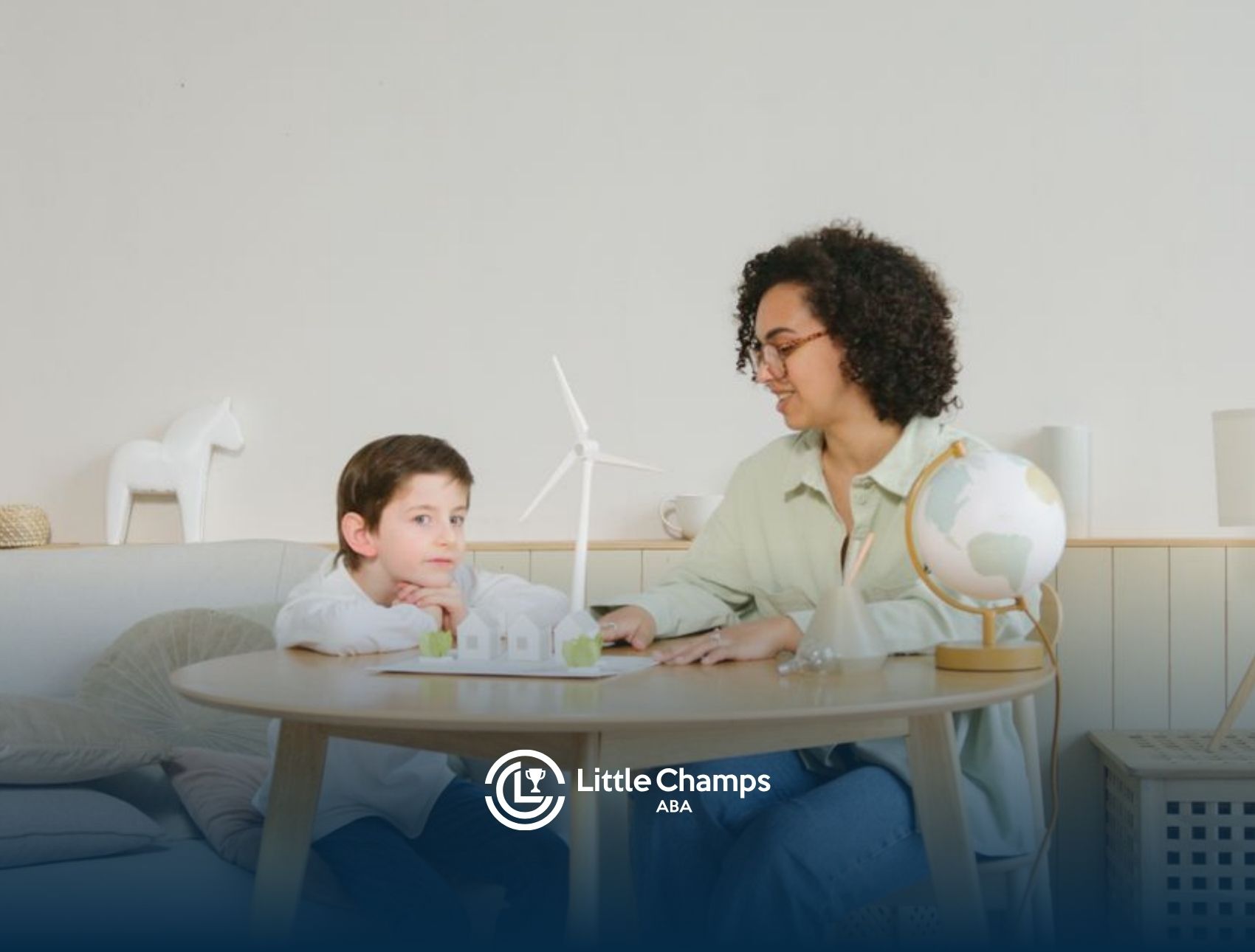
You’ve arranged ABA therapy for your child, prepared for the first appointment, and wondered what the therapist will begin teaching. Then the session starts, and they spend much of the time playing with cars, building blocks, or blowing bubbles.
It’s reasonable to wonder whether enough learning is happening.
This early stage is often called pairing in ABA. Pairing ABA techniques help a therapist build a positive relationship with a child by joining enjoyable activities, respecting preferences, and becoming someone the child feels comfortable approaching.
The first sessions may look informal, but the therapist should be observing, learning, and making purposeful decisions about how to support your child.
At Little Champs ABA, we recognize that children learn best when their individual needs, interests, and communication are understood.
What Is Pairing in ABA Therapy?
Pairing is the process of building positive associations between the child, the therapist, and the therapy environment.
In behavioral terms, therapists aim to become associated with experiences the child enjoys. This can help establish rapport, a comfortable and trusting working relationship.
For example, a therapist might notice that your child loves toy trains. Rather than immediately directing the game, they may sit nearby, offer another train, and allow your child to decide whether to include them.
The CDC’s overview of autism interventions describes behavioral and naturalistic approaches, including approaches that use play and children’s interests to support learning.
Pairing draws on these same principles of individualized motivation and engagement.
What Pairing ABA Looks Like During the First Sessions
Pairing looks different depending on the child. Some children seek interaction immediately, while others need more space, time, or predictability.
Here is what we typically focus on during early sessions.
Following your child’s interests
A therapist may join your child’s favorite activity without changing its purpose.
If your child is arranging toy animals in a particular order, the therapist might offer additional animals rather than interrupting the pattern.
The aim is to discover how your child likes to play and whether shared participation feels welcome.
Observing communication and sensory preferences
We pay attention to subtle signals.
Does your child move closer when the therapist sings? Do they turn away when someone speaks loudly? Do they request more bubbles through a gesture, word, or communication device?
These observations help guide future teaching and environmental accommodations.
Introducing small opportunities for interaction
When your child appears comfortable, the therapist may introduce brief learning opportunities through play.
For example, they may model a word, offer a choice between two toys, or practice requesting another turn.
This connects naturally with our approach to natural environment teaching.
How Pairing Builds Trust Before Structured Learning
A child’s willingness to participate tells us something important about the fit between the learner, the activity, and the environment.
In clinical planning, we look beyond whether a child completes an instruction. We also consider how they experience the interaction.
Recognizing assent and refusal
Assent refers to a child’s willingness to participate. It may be communicated through words, gestures, approaching materials, or voluntarily joining an activity.
Withdrawal of assent may include moving away, saying no, pushing materials aside, or showing distress.
A discussion of compassionate ABA practice emphasizes ongoing attention to assent throughout treatment.
When a child declines an activity, we should respond thoughtfully, reassess the situation, and offer appropriate alternatives while maintaining necessary safety boundaries.
Understanding the difference between rapport and reinforcement
Pairing often involves reinforcement, but parents should understand the distinction.
Reinforcement occurs when a consequence increases the likelihood of a behavior happening again.
During pairing, enjoyable experiences are generally offered freely. They should not depend on completing unnecessary demands.
Later, individualized reinforcement strategies may support learning goals. Our guide to positive reinforcement explores that process.
How Do You Know Pairing Is Working?
We don’t judge successful pairing by how many instructions a child follows during the first appointment.
Instead, we look for changes that suggest the child is becoming more comfortable with the therapist.
Possible signs include:
- Approaching the therapist voluntarily
- Bringing a favorite toy to share
- Accepting or requesting help
- Initiating an enjoyable activity together
- Communicating preferences or boundaries
- Returning to an interaction after taking a break
These behaviors are meaningful observations, although none is required to demonstrate trust.
For example, imagine a child who initially watches the therapist play from across the room. Several visits later, the child independently brings over a toy.
That shift can be encouraging even if structured skill targets are still limited.
A 2025 qualitative study of caregiver involvement involving 18 caregivers and ABA professionals identified relationship-building and communication among factors supporting home-based services. The small study highlights their importance without establishing a universal formula for successful pairing.
How Long Should Pairing Last in ABA?
There is no fixed number of sessions.
Some children settle into the relationship quickly. Others need additional time, especially when they have experienced difficult therapies, significant anxiety, or unfamiliar environments.
Pairing should also continue after the introductory period.
A therapist may spend a few minutes reconnecting with a child at the beginning of each visit, particularly after an absence or stressful day.
Parents can ask how the team is balancing rapport-building with individualized treatment goals. Our article about the first ABA session offers additional preparation tips.
What Parents Can Do During the Pairing Process
You know details about your child’s comfort and preferences that may take a new therapist time to discover.
Sharing that knowledge helps the team make better decisions from the beginning.
Consider telling your therapist:
- Which toys, topics, and activities your child loves
- What sensory experiences they find overwhelming
- How they communicate discomfort or refusal
- Whether they prefer adults to sit nearby or join play
- What helps them recover after a difficult moment
You can also ask about the session plan, how the team recognizes assent, and when new goals will be introduced.
Our discussion of autistic child autonomy explains why choice and communication should remain central throughout therapy.
Where Families Can Access Individualized ABA Therapy
Pairing can happen in the living room, classroom, daycare, or therapy center. Each setting offers different opportunities for a therapist to learn about the child.
At Little Champs ABA, we tailor our approach to the child’s abilities and everyday environment.
Families can explore:
- Center-based ABA therapy at our Cottonwood Heights location
- ABA therapy at home for relationship-building within familiar routines
- ABA therapy in school for classroom participation and collaboration
- ABA therapy in daycare for early play and communication
- ABA therapy for teenagers focused on age-appropriate goals and self-advocacy
- Telehealth ABA for suitable remote services and caregiver coaching
Our teams support families in Colorado, Utah, Georgia, and Virginia, depending on local service availability.
If you’re considering treatment, you can review our ABA insurance options and request an individualized benefits check.
A Strong Start Creates Room for Learning
Pairing ABA is one of the ways we begin understanding how a child experiences therapy. The quality of those early interactions can shape how we approach future teaching.
You should see a therapist who is curious about your child, attentive to communication, and willing to adjust when something feels uncomfortable.
At Little Champs ABA, we believe families deserve to understand every stage of their child’s treatment. Reach out to our team to learn what the first sessions may look like for your child.
Frequently Asked Questions About Pairing ABA
Is playing during ABA therapy productive?
Yes, when the play is responsive to the child’s interests and connected to purposeful clinical observations or learning opportunities. Parents should be able to ask what the therapist is observing and why.
How many sessions should ABA pairing take?
There is no standard duration. The pace depends on the child’s responses, comfort, communication, and individual needs.
What if my child does not like their ABA therapist?
Tell the supervising BCBA. The team should examine the environment, interaction style, sensory demands, and the child’s communication before deciding how to proceed. Sometimes changes in approach or staffing are appropriate.
Should pairing stop once formal teaching begins?
No. Rapport requires ongoing attention. Therapists should continue incorporating enjoyable interactions, meaningful choices, and responsiveness to the child’s preferences throughout treatment.
Sources
Centers for Disease Control and Prevention. (2024). Treatment and intervention for autism spectrum disorder. https://www.cdc.gov/autism/treatment/index.html
Araiba, S., & Čolić, M. (2022). Preliminary practice recommendations for telehealth direct applied behavior analysis services with children with autism. https://pmc.ncbi.nlm.nih.gov/articles/PMC9013273/
Ferretti, L. A., Uhl, A., Zawacki, J., & McCallion, P. (2025). Understanding barriers and facilitators of parent/caregiver involvement in home-based applied behavioral analysis programming for their autistic child. https://pmc.ncbi.nlm.nih.gov/articles/PMC12293302/
National Clearinghouse on Autism Evidence and Practice. (2020). Evidence-based practices for children, youth, and young adults with autism. https://ncaep.fpg.unc.edu/research-and-resources/
Autism Focused Intervention Resources and Modules. (n.d.). AFIRM modules. https://afirm.fpg.unc.edu/afirm-modules/
Behavior Analyst Certification Board. (2022). Ethics code for behavior analysts. https://www.bacb.com/ethics-information/ethics-codes/