


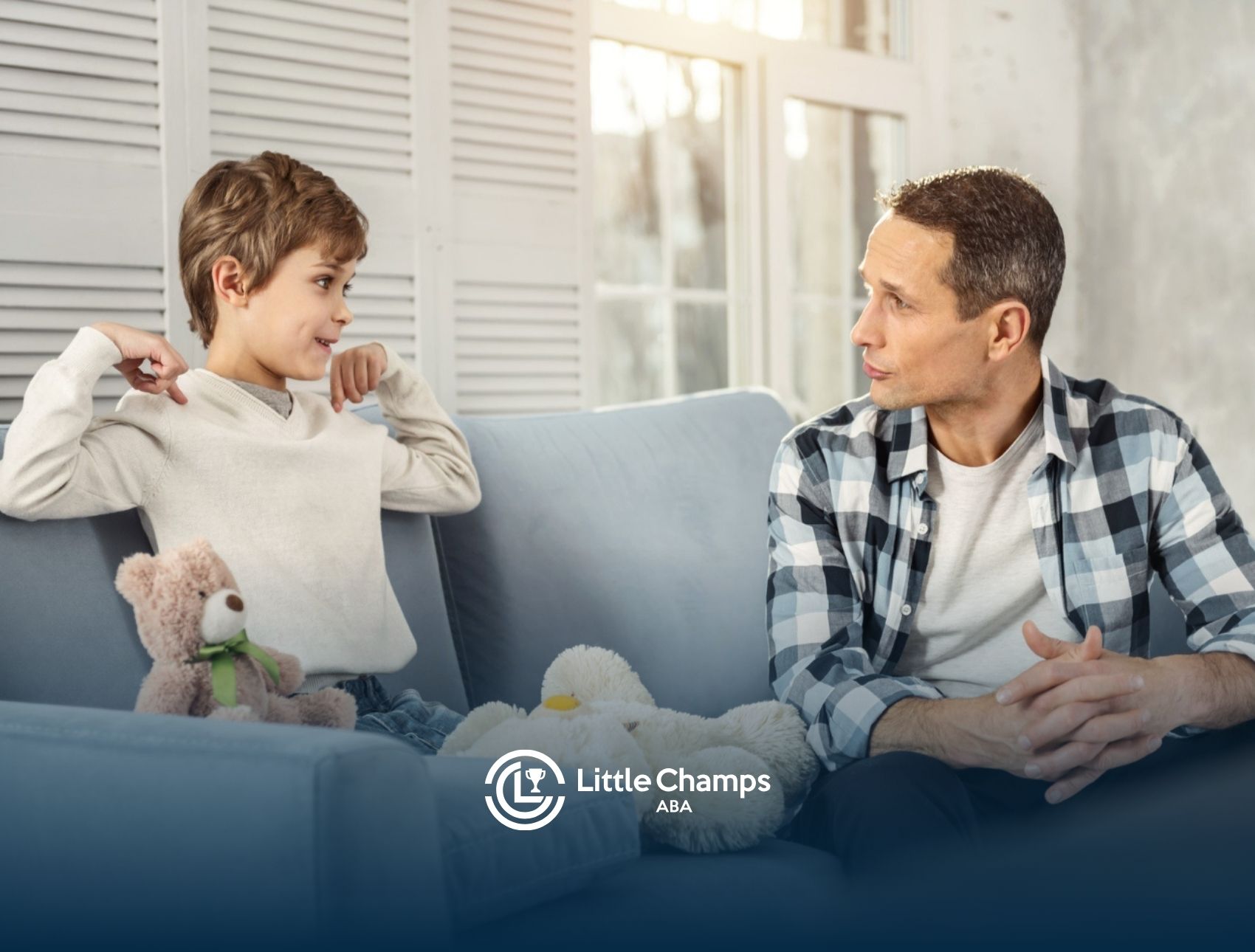
A dad called me on a Tuesday afternoon, mortified. His seven-year-old had pulled his pants down in the middle of a busy grocery store, a stranger had said something unkind, and the comment stuck with him for days. He wanted to know what he had done wrong. The honest answer was nothing. His son had learned that loosening his waistband made an itchy tag stop bothering him, and no one had ever taught him that the rule changes depending on which room he is standing in.
Teaching public vs. private behavior to autistic children comes up in nearly every intake conversation I have with families. These are location-based rules that most children absorb by quietly watching everyone around them, and many autistic kids need them taught directly, patiently, and without a drop of shame. What follows is the sequence we use in sessions at Little Champs ABA, plus what you can start doing at home this week.
What Public and Private Mean in a Child’s Daily Life
Before a rule can be followed, it has to be defined in words a child can hold onto. I break the concept into three separate buckets, because bundling them together tends to muddle things fast. A child who understands “the bathroom is private” does not automatically understand that scratching under a shirt belongs there too.
Private Places, Private Body Parts, Private Activities
Here is the breakdown I use with families, adapted to each child’s vocabulary level:
- Private places: a bedroom with the door closed, the bathroom, home when guests are not over.
- Public places: the classroom, the therapy center lobby, a store, the park, a car when a carpool friend is riding along.
- Private body parts: anything a swimsuit or underwear covers.
- Private activities: changing clothes, using the toilet, bathing, adjusting clothing, touching private parts, nose picking.
One detail that trips families up: the same room can flip categories. A living room is private on a quiet Sunday and public when the neighbors come over. I teach that shift on purpose rather than hoping a child infers it.
Where the Confusion Usually Shows Up
The behaviors that bring parents to us tend to cluster in a handful of predictable places:
- Undressing or partially undressing in shared rooms
- Leaving the bathroom door open
- Self-touch during unstructured downtime
- Hugging or standing very close to unfamiliar adults
- Announcing personal family information at volume in a waiting room
None of that is defiance. Each one is a behavior that works for the child in some way, performed in a setting where the social cost is high.
Why Privacy Rules Are Harder for Autistic Children to Pick Up
With about 1 in 31 eight-year-olds in the United States identified with autism according to CDC surveillance data, a lot of families are navigating this. Understanding why the skill is difficult changes how you teach it, and it usually lowers the temperature in the house.
The Rule Moves When the Room Moves
Most social rules are absolute in a child’s mind. Do not hit. Do not run into the street. Privacy rules refuse to behave that way. Taking a shirt off is fine, encouraged even, in one room and a problem twelve feet away in another.
Neurotypical children usually crack this code through social referencing, glancing at peers and adjusting in real time. When that referencing happens less often, the pattern never assembles on its own. The information has to be delivered, not absorbed.
The Behavior Is Doing a Job
Every time I assess one of these behaviors, I look for what it accomplishes. Sensory relief is the most common answer I find: a seam, a tag, sweat, a fabric texture, or simple physical comfort. Regulation is second, particularly self-touch during boredom or anxiety.
That matching of behavior to function is the backbone of applied behavior analysis, which NICHD describes among the behavioral approaches used with autistic children. If you remove a behavior without addressing what it was accomplishing, something else fills the gap. This is closely tied to the broader safety skills work we do around personal space and boundaries.
How We Teach Public vs. Private Behavior in ABA Sessions
Our sequence is deliberately slow at the front end. Rushing to correction produces a child who stops in front of you and continues everywhere else. The four steps below usually unfold across weeks, not days.
Sort Places Before Touching the Behavior
We start with photographs of the child’s real environments: their actual bedroom, their actual classroom, the car, Grandma’s kitchen. The child sorts each photo into a private pile and a public pile, with heavy reinforcement for correct sorting.
No behavior is discussed yet. We are building the category first. One kindergartener I worked with needed close to three weeks of sorting before the concept held, and once it did, the rest moved quickly.
Pair the Rule With a Visual and a Short Story
Social narratives, brief personalized stories describing a situation and the expected response, meet the criteria for an evidence-based practice according to the AFIRM team at UNC Chapel Hill. Ours are usually four to six sentences, written in the child’s voice, illustrated with their own photos.
Alongside the story we post a small visual: a door icon for private, a group-of-people icon for public. Some families keep a laminated card on the fridge and one in a backpack pocket.
Give the Child a Private Alternative
This step gets skipped most often, and it is the one that makes the difference. If undressing is about an itchy waistband, the child needs a way to say so and a place to go. We teach a request, verbal or with a card, plus a taught route: ask, walk to the bedroom or bathroom, adjust, come back.
For self-touch, the plan often pairs a private-space rule with a regulation strategy that works in public, such as a fidget or a movement break. Families who have read our guidance on what to avoid will recognize the principle: never leave a child with a prohibition and no replacement.
Practice Where the Skill Has to Hold
A privacy rule learned in a therapy room stays in the therapy room unless we deliberately move it. Generalization is planned, not hoped for, and it is one of the clearer benefits of ABA when programming is built well.
In practice this means rehearsing in the classroom, the daycare bathroom, the car, and the grandparents’ house, with the same visual and the same wording in each. Broader social skills training supports the same goal, since privacy sits inside a larger set of social expectations.
Supporting Privacy Skills at Home Without Shame
Parents carry most of the practice hours, and the emotional tone you set becomes part of what your child learns. Two habits do the heaviest lifting here.
Keep Your Wording Short, Neutral, and Identical
Long explanations delivered in a stressful moment rarely land. Pick one sentence per rule and repeat it word for word, every time, by every adult in the house:
- “Pants stay on in the living room. Bedroom for changing.”
- “Bathroom door closed, please.”
- “That is private. Your room is the private spot.”
Steer away from disgust language. Words like gross, dirty, and nasty attach a feeling to the child’s body rather than to the location, and that association is difficult to undo later.
Build Privacy Into Ordinary Routines
Children learn the concept faster when the household models it rather than only enforcing it. Small, consistent changes tend to work:
- Knock before entering your child’s room, and ask them to knock before entering yours.
- Move all dressing and changing into the bedroom or bathroom, even when it is less convenient.
- Narrate the rule out loud about yourself: “I am going to my room to change.”
- Give your child genuine private time so that private carries a positive association, not only a restrictive one.
Public and Private Behavior in Older Children and Teens
The stakes rise in adolescence, and the teaching has to grow up alongside the child. Puberty brings new bodies, new impulses, and social consequences that are considerably less forgiving than they were at age six. Families often notice this shift at the same time other adolescent challenges emerge.
Update the Language as Your Child Grows
Anatomically correct terminology becomes important, both for dignity and for safety reporting. A teenager who can name body parts accurately is better positioned to disclose if something happens. Cartoon icons give way to written checklists or phone reminders.
Fold in Consent and Body Safety
Privacy teaching in the teen years extends naturally into consent, appropriate touch, and who is permitted to see or touch a private body part and under what circumstances, such as a doctor during an exam with a parent present. Digital privacy belongs here too, since photos, video calls, and messaging apps have their own public and private boundaries that are not obvious to many teens.
How We Support Families in Colorado and Utah
Privacy and body autonomy goals show up across nearly every setting a child moves through, so we build programming that follows the child rather than staying in one room. Our BCBAs write these goals into individualized plans and coach the adults in each environment so the rules stay consistent.
We provide ABA therapy in Colorado, Utah, Georgia, and Virginia through the following services:
- Center-based ABA therapy for structured teaching and peer practice
- ABA therapy at home where bedroom and bathroom routines take place
- ABA therapy in school to align expectations with classroom staff
- ABA therapy in daycare for younger children in group care
- ABA therapy for teenagers covering consent, hygiene, and body autonomy
- Telehealth ABA for parent coaching between sessions
Ready to talk it through? Reach out to our team for a conversation about your child’s goals. Bring the moments that worry you most, including the grocery store ones. Those are the details that make a plan useful.
Frequently Asked Questions
These are the questions parents ask me most often once we start working on this skill.
At What Age Should I Start Teaching Privacy Rules?
Around ages three to four is a reasonable starting point, roughly when a child begins participating in toileting and dressing routines. Starting early keeps the teaching calm and low pressure. If your child is older and this has not been addressed yet, the same sequence applies with age-appropriate wording.
Is Undressing in Public a Behavior Problem or a Sensory Issue?
It can be either, and it is frequently sensory in origin. Look for patterns: specific fabrics, waistbands, tags, heat, or times of day. A functional assessment by a BCBA can identify the driver, which then determines whether the plan emphasizes sensory-friendly clothing, a communication response, or both.
Will Teaching Privacy Rules Make My Child Feel Ashamed?
Not when the teaching stays neutral. Frame everything around location rather than the body, keep your tone matter of fact, and reinforce the correct choice generously. Shame tends to enter through adult reactions, not through the rule itself.
How Long Does This Skill Usually Take?
It varies widely depending on the child’s language level, the function of the behavior, and how consistent practice is across settings. Some families see meaningful change in six to eight weeks, others work on it across several months. Progress in one setting before another is normal and expected.
What If My Child Follows the Rule at Home but Not at School?
That is a generalization gap rather than a failure. The plan needs to be taught in the school setting with the same visuals and wording, which is why we coordinate directly with teachers and aides whenever a family consents to it.
Can Telehealth Help With Privacy Goals?
It works well for the parent coaching portion, where a BCBA observes routines in the home environment and adjusts your approach in real time. Direct instruction with young children generally works better in person, so many families use a combination.
Sources:
- CDC, Data and Statistics on Autism Spectrum Disorder: https://www.cdc.gov/autism/data-research/index.html
- NICHD (NIH), What are the treatments for autism: https://www.nichd.nih.gov/health/topics/autism/conditioninfo/treatments
- AFIRM, UNC Chapel Hill, Social Narratives Brief Packet: https://afirm.fpg.unc.edu/resource/social-narratives-brief-packet/