


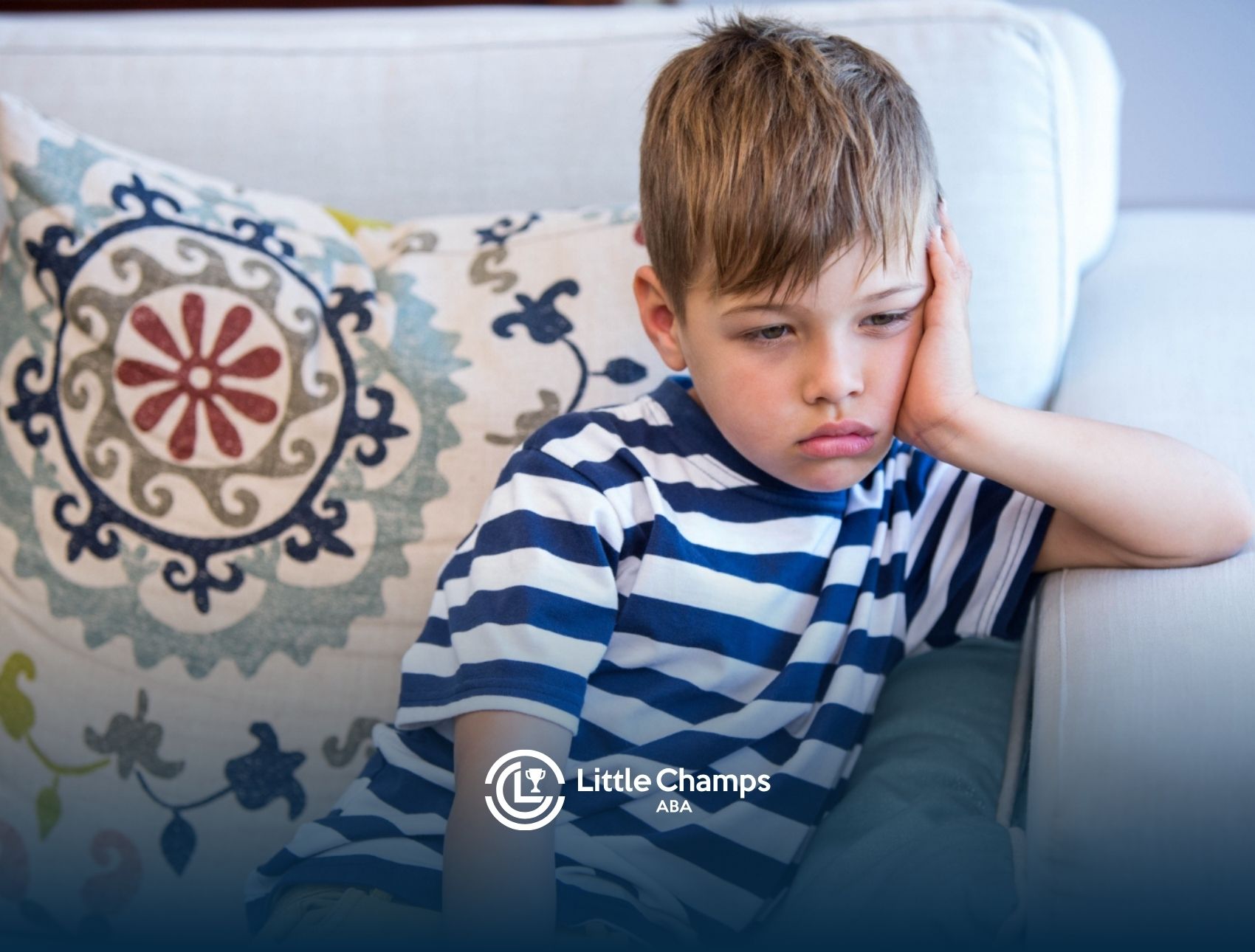
Interoception is the body’s internal sensing system, the one that reports hunger, thirst, pain, a full bladder, and a racing heart. Interoception in autism looks different from child to child, which is why some kids skip meals, miss bathroom cues, or show pain in ways adults overlook. At Little Champs ABA, we teach body awareness inside everyday routines, alongside families.
Interoception in Autism: What It Looks Like Day to Day
Many autistic children experience internal signals as too faint, too intense, or hard to label. Research is mixed, and a 2025 systematic review found studies pointing in different directions, so I treat every child as an individual profile.
Hunger, Thirst, and Tiredness
I see two patterns often. One child goes hours without eating, then unravels at 4 p.m. with no idea why. Another asks for snacks all day because “full” never registers clearly. A pooled analysis of 17 studies found autistic children were about five times as likely to have feeding problems (Sharp et al., 2013), so mealtime patterns such as rumination behavior deserve a closer look.
Afternoon crashes get labeled as behavior when hunger or fatigue played a part, a pattern worth keeping in mind with after-school meltdowns. Tiredness is a body signal too, and our post on melatonin research is a useful companion if sleep is a struggle.
Pain and Illness
Pain can be the hardest signal to read. One review of pain sensitivity concluded the belief that autistic people feel little pain deserves to be challenged, and that many children express discomfort differently, which can lead adults to assume nothing hurts. A scoping review of pain communication recommends combining caregiver reports with careful observation and picture supports (Johnson et al., 2023).
Watch for changes in sleep, eating, rubbing, guarding a body part, or new aggression. Sudden behavior change is my cue to call the pediatrician before writing any behavior plan. I have seen a child who suddenly refused headphones turn out to have an ear infection.
Toileting and Bathroom Signals
A full bladder or bowel sends a quiet message, and some children register it only at the last second. Others sense it and avoid the bathroom because of the flush or the feel of the seat. Before writing a toileting program, I ask families to rule out constipation with their pediatrician.
NIH’s guidance on constipation lists fewer than two bowel movements a week, hard or lumpy stools, and stools that hurt to pass. It advises a doctor visit if the problem lasts more than two weeks.
Big Feelings and Body Cues
A racing heart, tight stomach, or hot face often shows up before a meltdown. When children learn to notice those early cues, they gain a few seconds to ask for a break or a quiet space. We practice this during calm moments first, because nobody learns a new skill mid-meltdown.
How We Teach Body Awareness in ABA Therapy
Body awareness grows best inside real routines, not drills at a table. We begin with observation, then build the plan with the family, often alongside the pediatrician or an occupational therapist.
- Scheduled check-ins: a quick “What is your body saying?” before snack, after play, and before leaving the house.
- Visual supports: a 1 to 5 hunger scale or a picture body map gives a child something concrete to point to.
- Narrated sensations: adults name cues as they happen, such as “Your cheeks look hot, you might need water.”
- A way to tell us: words, cards, or an AAC device for “hungry,” “ouch,” and “bathroom,” reinforced every time.
- Pattern tracking: data on the timing of accidents, refusals, and meltdowns often reveals the hidden cue.
Skills also need to travel, so we plan for generalization across home, school, and community. Progress varies from child to child, and we adjust the plan as we learn what helps.
Finding ABA Support for Body Signal Skills
We serve families across Colorado, Utah, Georgia, and Virginia, and the setting shapes how we teach. A family in Denver might choose in-home sessions so practice happens at real mealtimes and in the bathroom they use. A family in Salt Lake City might prefer our center, where snack and toilet breaks are built into the day. A family in Atlanta might want school and home using the same visuals.
Many plans, including Medicaid, Aetna, and United Healthcare, may cover ABA for an autism diagnosis. Our team can help you review your insurance coverage before you begin.
Our services include:
- Center-based ABA therapy
- ABA therapy at home
- ABA therapy in school
- ABA therapy in daycare
- ABA therapy for teenagers
- Telehealth ABA
Next Steps for Interoception in Autism
Interoception in autism rarely arrives with a label attached. It arrives as a skipped lunch, a puzzling accident, or a mood shift that comes out of nowhere. Try a one-week log of meals, bathroom trips, sleep, and rough moments, then share it with your pediatrician and with us.
Patterns often start to appear quickly, and they give your child’s team something concrete to work with. When you are ready, we would love to help your child learn to listen to their body: reach out to Little Champs ABA today.
FAQs About Interoception in Autism
Do all autistic children have trouble with interoception?
No. CDC surveillance identified about 1 in 31 eight-year-olds with autism in 2022, a broad group with very different profiles, and interoception research remains mixed.
Can children learn to notice body signals?
Many build stronger body awareness with consistent, individualized teaching, though pace and results differ.
Does a child who never complains of pain feel nothing?
Not necessarily. Many express pain through changes in sleep, eating, mood, or movement, so call your pediatrician when something shifts.
Sources
- Klein, M., Witthöft, M., & Jungmann, S. M. (2025). Interoception in individuals with autism spectrum disorder: A systematic literature review and meta-analysis. https://www.ncbi.nlm.nih.gov/pmc/articles/PMC12406136/
- Allely, C. S. (2013). Pain sensitivity and observer perception of pain in individuals with autistic spectrum disorder. https://www.ncbi.nlm.nih.gov/pmc/articles/PMC3697411/
- Johnson, E., van Zijl, K., & Kuyler, A. (2023). Pain communication in children with autism spectrum disorder: A scoping review. https://www.ncbi.nlm.nih.gov/pmc/articles/PMC10749405/
- National Institute of Diabetes and Digestive and Kidney Diseases. (n.d.). Constipation in children. https://www.niddk.nih.gov/health-information/digestive-diseases/constipation-children
- Sharp, W. G., Berry, R. C., McCracken, C., Nuhu, N. N., Marvel, E., Saulnier, C. A., Klin, A., Jones, W., & Jaquess, D. L. (2013). Feeding problems and nutrient intake in children with autism spectrum disorders: A meta-analysis and comprehensive review of the literature. https://doi.org/10.1007/s10803-013-1771-5
- MedlinePlus. (n.d.). Toilet training tips. https://medlineplus.gov/ency/patientinstructions/000944.htm