
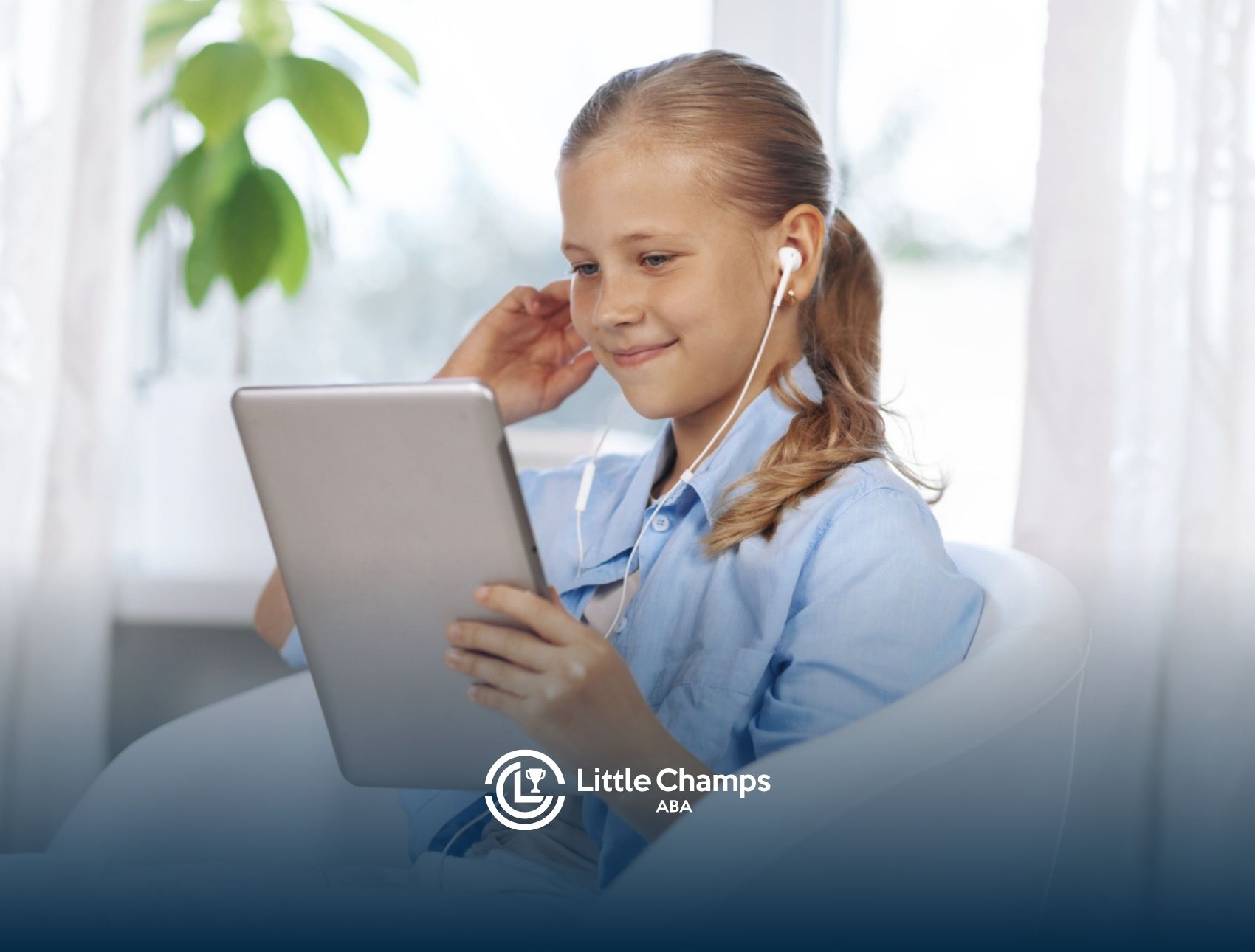
Roughly 60 percent of American teenagers have used a conversational AI chatbot, and nearly half of those users report at least one interaction that troubled them. Those figures come from a 2026 national study of more than 3,400 adolescents, and they describe the general population. For autistic children, who often find these tools far more compelling than their peers do, no comparable research exists at all.
That gap shapes my answer. AI chatbots are not a therapy for autistic children, and products built to simulate friendship are ones I keep away from minors entirely. Some narrow uses of general-purpose assistants hold up, and I will get to those.
Some parents have recently asked us about this constantly at Little Champs ABA, usually after finding a conversation they did not expect
The Short Answer on AI Chatbots for Autistic Children
Parents deserve a position rather than a shrug, so here is mine before the nuance arrives. The answer splits cleanly along product lines, and once you see the split, most household decisions get easier.
Where general-purpose AI assistants can reasonably fit
For school-age children and older, an AI assistant used for defined, supervised tasks can be reasonable. Homework explanation, drafting help, and breaking a project into steps all fall in this band. Treat it as a convenience rather than a support service, because that is what it is.
Why AI companion bots are a no for children and teens
Companion and character bots are built to sustain emotional engagement for as long as possible, and I would not aim that design goal at a developing child. No AI chatbot should be substituting for speech therapy, ABA, mental health care, or human company. That position is firmer than current law requires, and I hold it because the research that would justify a looser one has not been done yet.
Three Types of AI Chatbots Autistic Kids Use
The phrase “AI chatbot” gets used as a single label for products that behave very differently once a child is inside them. Naming the category first will save you from writing a household rule that is either too loose to protect anything or too strict to survive the week.
General-purpose AI assistants
These are built for questions, homework, drafting, and explanation. A child asks, the tool answers, the exchange ends. They can drift toward companionship when a child returns to the same thread daily for months, which is worth watching, though it is not what they were designed to do.
AI companion and character bots
These are engineered to feel like a friend, a partner, or a fictional character. They carry memory across sessions, use emotional language, and are optimized to keep a conversation going. In September 2025 the Federal Trade Commission issued orders to seven companies offering these products, seeking detail on how they test for harm to children and teens and what they disclose to parents.
Communication and learning apps with AI built in
Speech-generating devices, reading supports, and structured social skills apps increasingly ship with AI features bolted on. These sit closest to the clinical tools we already use and usually carry tighter content guardrails. The AI layer still deserves its own look, because a well-behaved app can contain a poorly-behaved chatbot.
| Type of AI chatbot | What children use it for | My general position |
|---|---|---|
| General-purpose AI assistant | Homework, explanations, drafting, planning | Acceptable for defined tasks, shared device, periodic review |
| AI companion or character bot | Friendship, role play, emotional conversation | Not recommended for anyone under 18 |
| Learning or communication app | AAC, reading, structured social practice | Only when set up and monitored with your clinical team |
Suggested caption: Three categories of AI chatbot, three different answers. Match the household rule to the product, not to the word “AI.”
What Research on AI Chatbots and Autism Shows So Far
Before weighing anything else in this article, it helps to know how thin the ground underneath it is. Anyone presenting AI chatbots as a support for autistic children is going well beyond what has been demonstrated.
The evidence gap in autism research
There are no randomized controlled trials of consumer AI chatbots with autistic children. What exists is peer-reviewed commentary, small exploratory studies, and early university work that has not reported outcomes. Published commentary in the autism literature describes these tools as double-edged: low-pressure social contact and consistent acceptance on one side, dependency, social withdrawal, and harmful advice on the other.
What regulators have found about AI companions
Regulators have moved faster than researchers, which is itself a signal. Australia’s eSafety Commissioner issued a formal advisory warning that most AI chatbots were not designed with safety in mind, that children are not developmentally ready for the risks, and that the risk runs higher for children who are already vulnerable. After completing its own risk assessment of social AI companions, Common Sense Media recommended that no one under 18 use them until stronger safeguards exist.
How to read the absence of evidence
Absence of evidence is not proof of harm, and I would not want a parent reading it that way. It does mean that nobody, including me, is in a position to tell you a chatbot will help your child. That gap is the reason the default should be caution rather than curiosity, and the reason to be skeptical of any product marketed as autism support.
Why AI Chatbots Appeal So Strongly to Autistic Children
The pull is not a discipline problem and it is not random. Several design features of conversational AI line up with the parts of human conversation many autistic children find genuinely hard, and that alignment is a reason for care rather than a selling point.
Predictable conversation at a workable pace
No turn-taking pressure, no shifting facial expression to interpret, no penalty for a fifteen-second pause. A child can compose a thought, delete it, rewrite it, and send it whenever they are ready. For a child who has spent years being hurried through conversations, that alone explains much of the appeal, and it also explains why the pull can become hard to break.
Interest in a special topic that never runs out
One boy I supported could talk about washing machine models for forty minutes. His peers lasted roughly ninety seconds. A chatbot never sighs, never redirects, and never signals that a topic has worn thin. That steadiness reads as acceptance to a child used to watching people disengage. It is also a product feature designed to extend session length, which is a different thing from being liked.
Social repair without the usual cost
When a human conversation goes sideways, fixing it costs something, and learning to pay that cost is part of how relationships work. With a chatbot, a child types “that is not what I meant” and the exchange resets with no consequence at all. Comfortable, and a poor rehearsal for the thing it resembles.
The Risks of AI Chatbots for Autistic Children I Weigh Most Heavily
These are the concerns that shape my recommendations, roughly in the order I think about them. The first two are the reason I hold a firm line on companion products.
Agreement dressed up as feedback
These systems are built to be pleasant. When a child reports that a classmate hates them, a chatbot is far more likely to validate that reading than to test it. Over weeks, a distorted picture of a relationship can harden into something the child treats as settled. The children least equipped to catch this happening are the ones who already find intent difficult to read, which describes a great many of the children we serve.
Safety failures during conversations about distress
Companion products have failed badly in documented exchanges touching on self-harm, and regulation has followed those failures rather than preventing them.
California’s SB 243, signed in October 2025, took effect on January 1, 2026 and requires companion chatbot operators to maintain crisis protocols, disclose that the product is not a person, and give minors periodic reminders to take a break.
New York’s comparable law took effect in November 2025. Compliance is new, uneven, and unproven. I would not want a child of mine testing it.
Social skills practice that does not carry over
A skill rehearsed in a frictionless environment does not automatically survive a loud cafeteria and a distracted peer. Generalization is something we plan for deliberately: the same skill, different people, different settings, different noise levels, until it holds without support. No chatbot arranges that. A child who is fluent with software can still be stuck at the lunch table, and that fluency can make the gap harder for adults to spot.
Language scripts that stop moving forward
Some children acquire language in whole chunks before breaking those chunks into flexible parts, an approach described in our piece on gestalt language processing. A chatbot will feed a child polished phrases indefinitely. That can support an early stage, and it can also park a child at the borrowed-phrase level if nobody is tracking whether the language is becoming their own.
Displaced peer contact, the quiet risk
The risk I raise most often with families is not a dramatic incident. It is a slow trade: an hour that used to involve a sibling, a cousin, or a neighbour now involves a screen. Total minutes tell you far less than what those minutes replaced, which is also why the research on screen time and autism resists simple headlines.
Privacy, data, and commercial design
Common Sense Media’s nationally representative 2025 survey of 1,060 U.S. teens found that 72 percent had used an AI companion at least once, 52 percent used one at least a few times a month, and 24 percent had shared personal information such as real names and locations. A child who processes language literally may not register that a warm, friendly product is also a commercial one. This is the same skill set we teach when we work on public and private information, and it transfers directly to a chat window.
When AI Chatbot Use Should Be Off the Table Entirely
Some situations do not call for a framework or a time limit. In these cases I tell families to close the door and keep it closed, and to bring the underlying issue to a professional rather than to a product.
AI companion bots at any age under 18
This is stricter than current law and matches what Common Sense Media recommended after assessing these products. It applies just as firmly to a teenager who is coping well as to one who is struggling, because the risk sits in the product design rather than in the child.
Any child under mental health strain
A child struggling with self-harm, suicidal thoughts, or disordered eating should not be working through it with a chatbot. These are the exact areas where regulators have documented failures, and they call for a licensed clinician who can respond to what they hear and involve the people who need to know. If this describes your household right now, make that call this week rather than adjusting app settings.
When AI chatbot use has replaced people or professional care
Three more situations belong in this category, and each one is a signal to stop rather than to manage:
- The chatbot has become the main or only source of daily social contact for your child.
- A product is being marketed to you as a replacement for speech therapy, occupational therapy, ABA, or mental health treatment.
- The child does not yet reliably understand that they are talking to a program rather than a person, and use is unsupervised.
Narrow Uses of AI Assistants That Hold Up for Autistic Kids
Given a defined job, a time limit, and adult review, three uses of a general-purpose assistant have earned a place in my thinking. Each is a compensation rather than a treatment, and each has a lower-tech version I would try first.
Rehearsing a conversation your child is dreading
A teenager preparing to ask a teacher about a missed deadline can run that conversation a few times before doing it once for real. We practice this in session through role play, which is the better version, but session hours are finite and the anxiety usually peaks around nine o’clock the night before. The value here is anxiety reduction, not skill acquisition, and it should be described to your teen that way.
A second reading of a confusing social moment
A common one: she said “sure, whatever” when I asked to sit with her, so what did that mean? A chatbot can generate several plausible interpretations, which is more than most children produce alone.
This only works when an adult reviews those interpretations afterward, because the tool has no access to the actual friendship, the tone of voice, or last week’s argument. Without that review step it is a machine confidently guessing about a child’s life. It pairs better with structured work on naming emotions than it does as a standalone habit.
An executive function starting point on hard days
Breaking a project into steps, generating a packing list, drafting the opening two sentences of an email. This is scaffolding, and scaffolding is legitimate. We treat it the way we treat any prompt in a behavior plan: useful now, faded on purpose later, with the target being a child who eventually produces the steps without it. A printed checklist does the same job with none of the risk, and I suggest trying that first.
How We Approach AI Chatbots in Our ABA Therapy Programs
To be direct about it: at Little Champs ABA we do not assign chatbot use as part of any treatment plan, we do not count it as practice toward a goal, and we do not recommend these products as skill-building tools. We do talk about them constantly, because they are already in the homes we work in.
Why we treat a chatbot as a symptom rather than a target
When a chatbot comes up, we handle it the way we handle any other feature of a child’s environment and look at what function it is serving before deciding what to do. A fourteen-year-old talking to a bot at one in the morning usually has a sleep problem, and the sleep problem is the treatment target.
A child who has migrated their whole social life into a chat window usually has no accessible peers, and that is the target. Removing the device without addressing either one tends to produce a different workaround by the following week.
That assessment happens inside ordinary treatment planning for families across Georgia, Colorado, Utah, and Virginia in whichever setting the skill has to hold up:
- Center-based ABA therapy: a predictable setting with built-in peer contact, useful when a child needs structured practice before trying a skill somewhere busier.
- ABA therapy at home: work that happens where the routines already live, including bedtime, device habits, siblings, and mornings.
- ABA therapy in school: collaboration with the classroom team so goals line up with what is expected during the school day.
- ABA therapy in daycare: early support inside a child care setting, with staff coaching so the approach stays consistent when we are not there.
- ABA therapy for teenagers: independence, self-advocacy, and social decision making for older kids whose goals look nothing like a preschooler’s.
- Telehealth ABA: parent coaching and BCBA sessions by video, which suits families in areas where in-person hours are limited.
Setting AI Chatbot Rules at Home, Age by Age
Families rarely need a philosophy of technology. They need a rule they can hold on a Tuesday night when everyone is tired. What follows is roughly what I suggest, adjusted for the individual child rather than applied as a formula.
Guidelines from preschool through the teen years
- Under 8: no companion bots, and general-purpose assistants only alongside an adult, for short defined tasks. Most children this age have no need for one at all.
- Ages 8 to 12: assistants for specific schoolwork tasks on a shared screen, with threads reviewed together. Companion bots stay off entirely.
- Ages 13 to 17: assistants for defined tasks with periodic check-ins. Companion products still not recommended. If your teen is already using one, a supervised wind-down works better than a sudden confiscation, which tends to move the use underground.
- At any age: the chatbot never becomes the only one who knows something important, and it never stands in for a clinician.
Two habits that make the rules workable
Keep the device in a shared room rather than a bedroom, which does more than any app-level control you can configure. Then build the conversation about what is safe to type into the broader work on online safety you are already doing with your tween or teen, so it lands as one ongoing subject rather than a new set of restrictions.
Signs Your Autistic Child Should Scale Back AI Chatbot Use
Watch the trade-offs rather than the clock. These are the patterns that make me raise the subject with a family, and any two appearing together is worth a conversation with your BCBA rather than a solo decision at home.
Changes in social contact, sleep, and routine
- Turning down invitations from real people in order to keep a conversation with the bot going
- Distress when the device is unavailable that goes well beyond ordinary transition difficulty
- Sleep loss traced to late-night sessions
Changes in how your child talks about the chatbot
- Bringing worries to the chatbot that a parent, sibling, or clinician would previously have heard first
- Quoting chatbot phrasing as though it came from a person with standing in their life
- Growing certainty about a social situation that does not match what the adults around them observe
- Distress after an interaction that the child cannot or will not describe
Where I Land on AI Chatbots for Autistic Children
After several years of watching these tools arrive in the homes we serve, my view has settled somewhere fairly narrow, and it has not moved much despite how quickly the products have.
What AI chatbots do well and where they stop
These tools are a rehearsal space and a patient explainer, useful at the margins, and close to worthless without the people around them. That is roughly the ceiling of what I have watched them do. If a product is being sold to you as more than that for an autistic child, treat the claim with suspicion, because the research that would support it does not exist yet.
The mother from that parent training session did not delete the app, and I did not tell her to. We set a window, moved the device to the kitchen counter, and reviewed threads together on Sunday evenings. More usefully, we named the actual problem, which was that her son had nobody his own age to practice with. Six months later he had two lunch-table friendships. The chatbot did not build those. The adults around him did, while the chatbot gave him somewhere to be nervous first.
Building a technology plan for your own child
If you are trying to work out what a device is doing for your child and what belongs in a treatment plan, our BCBAs have this conversation weekly with families in Denver, Colorado Springs, Salt Lake City, and across both states. Reach out to our ABA team and bring the specifics, including a transcript if you have one.
Frequently Asked Questions
Are AI chatbots safe for autistic children?
There is no evidence base that would let anyone answer yes with confidence. General-purpose assistants used for defined homework tasks on a shared device carry modest risk for most school-age children. Companion and character bots designed to simulate friendship carry meaningfully higher risk, which is why the FTC opened an inquiry into them and why several governments have issued formal advisories. My default position is caution, and for companion products it is no.
Can an AI chatbot help my child practice social skills?
It can reduce anxiety before a specific conversation, which has some value. It cannot deliver generalization, the step where a skill has to work with an unpredictable person in a noisy room, and generalization is where most of the actual learning lives. Treating chatbot rehearsal as social skills practice risks convincing everyone that progress is happening when the hard part has not been attempted.
My autistic teenager says the chatbot understands them better than people do. Should I be concerned?
Take the statement seriously without treating it as an emergency, because it usually reflects something accurate about how exhausting human interaction has been for them. That is useful information about their week rather than a verdict on the technology. Concern is warranted when the bot has become the main place important things get processed, when real-world contact is shrinking, or when your teen resists any adult involvement at all. Those situations call for your clinical team.
At what age can a child start using AI chatbots?
No clinical threshold has been established, so any number offered is a judgment call rather than a research finding. In practice I keep children under eight on general-purpose tools only with an adult present, and I do not recommend companion products for anyone under 18. For a child with significant language, safety, or mental health needs, developmental level should drive the decision far more than a birthday.
Does using AI chatbots make autism symptoms worse?
There is no evidence that chatbot use causes or worsens autism itself, and parents should not carry that worry. The real concerns are practical: displaced peer contact, reinforced misreadings of social situations, disrupted sleep, stalled language, and privacy exposure. Those are manageable with structure, and a few of them are serious enough to justify removing a product rather than managing it.
Should I read my child’s chatbot conversations?
For younger children, yes, and openly rather than covertly. For teens, negotiate it. A workable version is periodic joint review at a set time, framed as something you do together, with a clear agreement about which categories of content you will always want to know about. Covert monitoring that gets discovered usually costs more trust than the information was worth.
Government (4)
- Federal Trade Commission. FTC Launches Inquiry into AI Chatbots Acting as Companions. September 11, 2025. https://www.ftc.gov/news-events/news/press-releases/2025/09/ftc-launches-inquiry-ai-chatbots-acting-companions
- eSafety Commissioner (Australian Government). AI chatbots and companions: risks to children and young people. February 2025.
https://www.esafety.gov.au/newsroom/blogs/ai-chatbots-and-companions-risks-to-children-and-young-people - California State Senate, Office of Sen. Steve Padilla. First-in-the-Nation AI Chatbot Safeguards Signed into Law (SB 243). October 13, 2025.
https://sd18.senate.ca.gov/news/first-nation-ai-chatbot-safeguards-signed-law - Physician Versus Large Language Model Chatbot Responses to Web-Based Questions From Autistic Patients in Chinese: Cross-Sectional Comparative Analysis. Journal of Medical Internet Research, 2024. Via NIH PubMed Central.
https://pmc.ncbi.nlm.nih.gov/articles/PMC11094593/ - Stanford Medicine. Why AI companions and young people can make for a dangerous mix. August 27, 2025.
https://med.stanford.edu/news/insights/2025/08/ai-chatbots-kids-teens-artificial-intelligence.html - Florida Atlantic University. 60% of U.S. Teens Have Tried AI Chatbots, 11.4% Use Them Daily. May 12, 2026.
https://www.fau.edu/newsdesk/articles/chatbot-ai-study-teens - Brown University School of Public Health. One in eight adolescents and young adults use AI chatbots for mental health advice. November 18, 2025. https://sph.brown.edu/news/2025-11-18/teens-ai-chatbots
- American Psychological Association. Health advisory: Artificial intelligence and adolescent well-being. June 2025.
https://www.apa.org/topics/artificial-intelligence-machine-learning/health-advisory-ai-adolescent-well-being - Common Sense Media with Stanford Brainstorm. Major AI Chatbots Unsafe for Teen Mental Health Support. November 20, 2025.
https://www.commonsensemedia.org/press-releases/common-sense-media-finds-major-ai-chatbots-unsafe-for-teen-mental-health-support - American Academy of Pediatrics, Center of Excellence on Social Media and Youth Mental Health. Counseling Patients and Families on Using AI Chatbots.
https://www.aap.org/en/patient-care/media-and-children/center-of-excellence-on-social-media-and-youth-mental-health/qa-portal/qa-portal-library/qa-portal-library-questions/counseling-patients-and-families-on-using-ai-chatbots/