


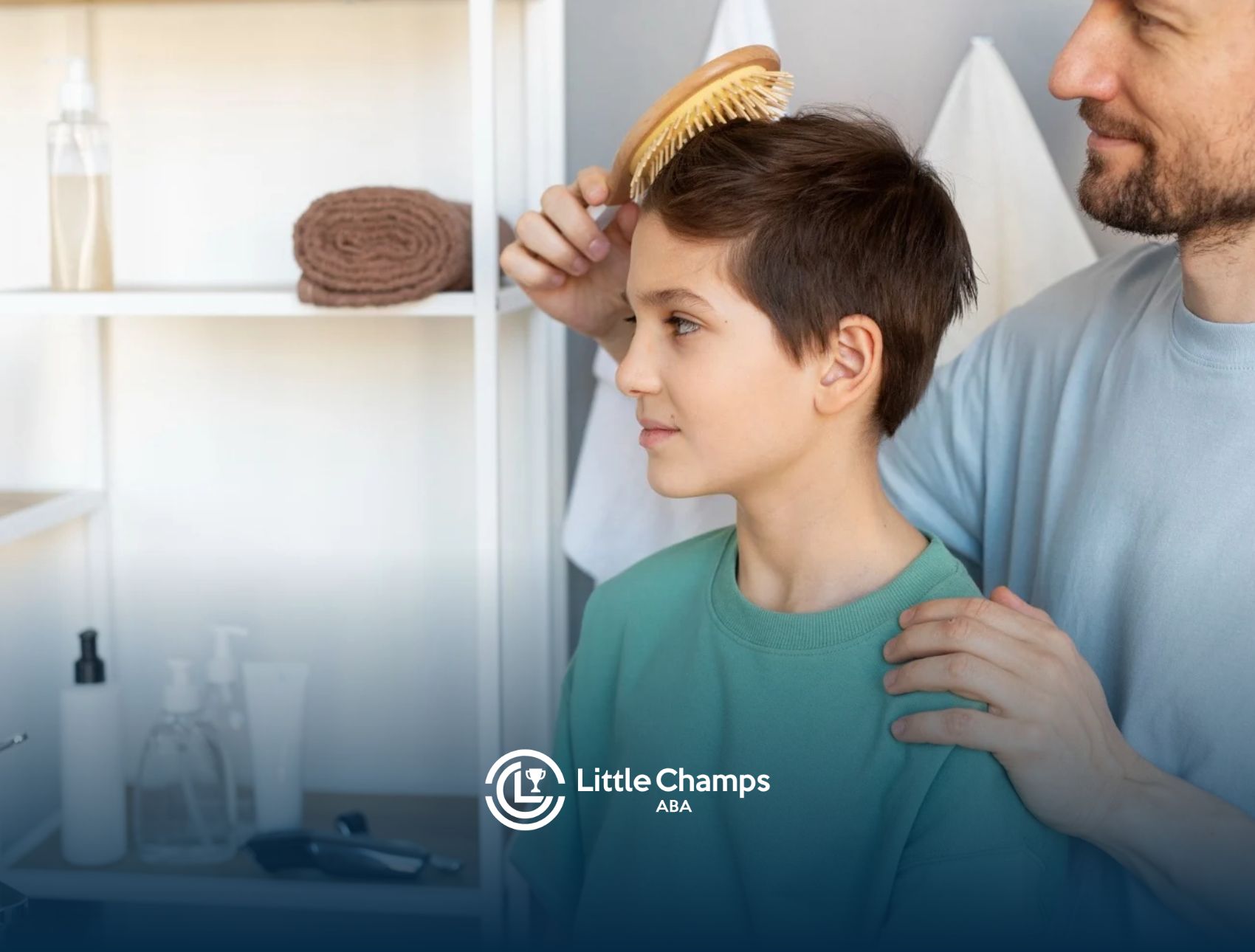
Personal hygiene skills for autistic teens can be taught, and the approach that works best looks a lot like good ABA anywhere: break the routine into small steps, make each step visible, practice in a calm setting, and reinforce progress.
At Little Champs ABA, we help teens and families build these everyday habits because self-care sits at the center of independence.
What follows covers what we see in practice, how we teach it, how to troubleshoot when routines stall, and when extra support makes sense.
Why Autism Hygiene Gets Harder During the Teen Years
Adolescence brings more steps, less adult supervision, and higher social expectations all at once. For autistic teens, differences in sensory processing, body awareness, planning, and social feedback can make that jump steep. Knowing which factor is driving the struggle tells you where to start.
Sensory experiences that make routines uncomfortable
Water pressure can feel sharp. Shampoo scent can be overwhelming, a rough towel can be unbearable, and the taste of toothpaste can make a teen gag. When a teen resists the shower, I look at the sensory load before I assume defiance.
Small changes often help: unscented products, a handheld showerhead on a gentle setting, a soft towel the teen chooses, and a consistent water temperature.
Body signals that are hard to notice
Many autistic teens do not register sweat, oily hair, or a dry mouth until someone points it out. This connects to interoception, the sense of what is happening inside the body, which we explain in our post on interoception.
Because the internal cue is faint, we pair routines with outside cues such as a time on a schedule, a phone alarm, or a checklist on the bathroom door.
Planning and sequencing
A thorough shower means remembering a dozen steps in order, adjusting the water, and managing time. Teens who struggle with executive functioning may skip steps, repeat steps, or lose track of where they are halfway through.
This is a skill gap and not a motivation problem, which is why a visual sequence works better than another reminder.
Unwritten social rules
Others notice body odor, greasy hair, or wrinkled clothing, and it can affect friendships. Yet teens are rarely told directly, and autistic teens may not pick up on hints.
We teach the rules plainly. For example: “On shower days, deodorant goes on after you dry off, and a clean shirt goes on after that.” Clear rules reduce guessing and protect your teen’s dignity.
Stress, mood, and energy
Self-care often slips when a teen is anxious, exhausted, or low in mood. If a teen who previously managed routines starts neglecting them, mention it to your pediatrician before assuming it is a skill issue.
What Good Hygiene Teaching Looks Like Before You Start
Preparation saves weeks of frustration. A few decisions at the beginning shape how willing your teen will be to practice, and how well the skills last.
Start with your teen
Teens are more cooperative when they have a say. Ask which routine bothers them most, which products they prefer, and when they would like to shower. Let them pick the soap, the towel, and the order of the steps wherever you can.
Privacy matters at this age. Teach from the doorway, a shared visual, or a short coaching session before the routine, rather than standing in the bathroom.
Pick targets and watch a baseline
Choose one or two routines and watch what your teen does now without help. Note which steps they complete on their own, which need a reminder, and which they skip entirely. That baseline shows where to begin teaching and gives you something to compare against in a few weeks.
Set up the bathroom for success
The environment can do half the teaching:
- Keep supplies in a caddy or labeled basket within reach
- Post a step card at eye level, where the routine happens
- Use a waterproof timer for brushing and showering
- Add a non-slip mat, a hook for clean clothes, and a bin for dirty ones
- Reduce clutter so the next step is easy to find
How to Build Personal Hygiene Skills for Autistic Teens
The methods below come from evidence-based ABA practice. The National Clearinghouse on Autism Evidence and Practice at UNC lists visual supports, video modeling, task analysis, and prompting among its 28 evidence-based practices for autistic children, youth, and young adults.
Here is how that looks in a bathroom.
Start with a task analysis
A task analysis breaks a routine into small, observable steps. Brushing teeth might look like this:
- Wet the toothbrush
- Add a pea-sized amount of toothpaste
- Brush the outside surfaces
- Brush the inside and chewing surfaces
- Brush the tongue
- Spit, rinse the mouth, and rinse the brush
Watch where your teen gets stuck, then teach that step directly instead of repeating the whole routine.
Add visual supports and video modeling
A laminated step card taped to the mirror is more patient than any parent at 7:15 a.m. Use photos or simple line drawings for teens who prefer pictures, and written lists for teens who prefer words.
For teens who learn by watching, short video modeling clips of a peer, a sibling, or the teen completing a step turn an abstract instruction into something concrete.
Prompt, reinforce, and fade
Give only as much help as your teen needs to succeed, then reduce it. Backward chaining works well: you complete most of the routine together, the teen finishes the last step alone, and you move that independence earlier over time. Most teens enjoy that early success, which builds motivation.
Prompts can move from a hand-over-hand guide, to a gesture, to a point at the visual, to a quiet “What’s next?” and finally to nothing at all. Fading too quickly leads to errors, and fading too slowly leads to dependence on a person.
Choose reinforcement that suits a teenager
Reinforcement works best when it is meaningful and age-appropriate. Options include extra gaming time, a favorite snack, a point toward a goal your teen chose, or simply control over the playlist during the routine.
Praise effort specifically (“You rinsed all the soap out of your hair”) rather than generally. Over time, the natural benefits of feeling fresh and having smooth mornings take over some of the work.
Track progress in a simple way
A weekly tally on the fridge is plenty: which steps happened independently, which needed a reminder, and which were skipped. Progress is rarely a straight line, and a chart helps you notice gains during weeks that feel hard. A BCBA can also turn these notes into graphs to guide changes to the plan.
Daily Hygiene Routines to Teach First
Fixing everything at once overwhelms teens and parents alike. Choose one or two routines with the biggest daily payoff, build them until they are steady, and then add the next.
Handwashing and nail care
Handwashing is a strong first target because the steps are short and the benefits are easy to see. The CDC outlines five steps: wet, lather, scrub for at least 20 seconds, rinse, and dry. A visual with these steps beside the sink helps, and a short song or timer makes the 20 seconds concrete.
Teach key times to wash as well: before eating, after using the toilet, and after coughing or sneezing. Nail care fits naturally here, and our tips on nail trimming explain how to lower the stress around it.
Teeth, face, and hair
Attach teeth brushing to something already fixed in the day, such as breakfast and bedtime. If texture or taste is a barrier, trial different toothpastes, a softer brush, or an electric brush with a gentle setting.
For hair, put wash days on a visual calendar so the teen is never surprised. A quick mirror check at the end (“Is my face clean? Is my hair combed?”) builds self-monitoring.
Showering or bathing
The shower is the most complex routine, so teach it in sections. A simple sequence might be:
- Gather towel and clean clothes
- Turn on the water and check the temperature
- Wet hair and body
- Shampoo, rinse, and condition if used
- Wash body with soap, then rinse
- Turn off the water and dry off
- Put on clean clothes and hang the towel
Start with a single section, such as hair washing, and expand when your teen is steady. Set a timer to prevent very long showers and use a checklist to prevent skipped steps.
Deodorant, clothing, and laundry
Link deodorant to the shower so the routine has a natural trigger. Use a two-bin system for clean and dirty clothes, and teach a simple rule such as “worn once, goes in the bin.”
Laundry becomes its own task analysis, and it doubles as a work skill later. Label the machine settings with a picture or color code, and keep the detergent measuring cup in view.
Sensory-Friendly Strategies That Make Routines Easier
When sensory discomfort is the barrier, teaching steps alone will not be enough. These strategies reduce the load so your teen can learn.
Touch and temperature
Let your teen test water temperature with a thermometer or a marked dial. Try a shower chair or a shorter shower if standing is tiring, and warm the bathroom beforehand. Choose towels, washcloths, and clothing tags that your teen tolerates.
Smell and taste
Unscented soap, shampoo, and deodorant are often easier to accept. Offer two or three options and let your teen sniff-test each. For toothpaste, mild flavors or unflavored options can ease gagging.
Sound and light
Fans, echoing tile, and bright overhead lights can add stress. Try a dimmer light, turning off the fan during routines, or playing soft music. Offer headphones if the hair dryer is the issue.
Gradual exposure
For strong aversions, break the routine into very small approximations and reinforce each one. A teen who panics at a hairbrush might start by holding it, then touching it to their hand, then brushing for two strokes, then five. This gradual approach respects the teen’s limits while building tolerance.
Troubleshooting Common Hygiene Roadblocks
Even a well-designed plan hits snags. These are the problems we hear about most, and the first things we try.
The teen refuses
Check for sensory pain, fear, or a routine that is too long. Offer choices (“Shower before dinner or after?”), shorten the first goal, and reinforce any approach toward the task. Avoid power struggles, which tend to harden refusal.
Steps get skipped or rushed
Add a checklist with checkboxes the teen marks off, and a mirror check at the end. If rushing continues, a timer for minimum time per step can help, such as two minutes for teeth.
The teen needs constant reminders
Shift from verbal reminders to visual or time-based cues. A phone alarm labeled with the routine puts the prompt in a neutral place instead of in a parent’s voice. Fade reminders slowly and reinforce independent starts.
Skills work at home but not elsewhere
Practicing across settings is called generalization. Rehearse hygiene routines on trips, at a grandparent’s house, at camp, and after gym class, using a portable version of the step card. Our school-based teams can also coordinate with staff for restroom and locker-room routines.
When to Bring In Your Care Team
Some hygiene struggles go beyond routine teaching. Skin irritation, pain, or strong avoidance deserve a closer look from your teen’s pediatrician or an occupational therapist. The CDC notes that occupational therapy can teach skills such as bathing and dressing alongside behavioral approaches.
Topics tied to puberty and private body care are best handled by parents together with the child’s doctor, in a way that fits your family’s values. Our part is supporting the daily routines around them.
Signs a routine needs a closer look
- Distress or pain during washing, brushing, or dressing
- Skin redness, rashes, or injuries
- Refusal that spreads from one routine to others
- A sudden drop in routines your teen used to manage
- Progress that stalls after several weeks of consistent teaching
A BCBA can assess what is driving the pattern and coordinate with your teen’s other providers.
ABA Support for Teen Self-Care Across Colorado, Utah, Georgia, and Virginia
Families often tell us they have tried charts and reminders without lasting change. One Utah teen we supported (details changed) avoided showers for weeks, and the barrier turned out to be the spray from a fixed showerhead. A handheld head and a six-step visual turned a daily battle into a routine his parents could supervise from the hallway. Some steps still need reminders, but the conflict ended.
Our teams serve families in Colorado, Utah, Georgia, and Virginia. Service options vary by location, so reach out to confirm what is available near you.
- Center-based ABA therapy: structured practice in a purpose-built space with BCBA oversight
- ABA therapy at home: teaching routines in the bathroom where they happen, with parents learning alongside
- ABA therapy in school: support for restroom, lunch, and gym-change routines during the school day
- ABA therapy in daycare: early self-care habits for younger siblings in your family
- ABA therapy for teenagers: goals built around your teen’s independence and preferences
- Telehealth ABA: parent coaching and check-ins by video
Call us at or reach out through our contact page to talk through where your teen is now and what support could look like.
FAQs Ask About Autism Hygiene
Is there an age when autistic teens should be fully independent with hygiene?
No single age fits every teen. Independence depends on your teen’s skills, sensory needs, and support needs. A BCBA can help set goals that move from full help to partial help to independence at a realistic pace.
What if my teen refuses to shower?
Start by looking at sensory comfort, predictability, and how many steps the routine has. Offer choices, shorten the routine, and reinforce small approximations such as simply turning on the water. If avoidance continues, ask your care team to take a closer look.
Can ABA therapy help with hygiene skills?
Yes. ABA uses task analysis, prompting, reinforcement, and parent training to teach self-care routines. Progress varies from teen to teen, and no program can promise a specific result.
How do I keep hygiene routines from becoming a daily fight?
Give your teen choices, use visuals in place of verbal nagging, and reinforce effort. Keep your tone neutral and your expectations clear, and adjust the plan if the same conflict repeats.
How long does it take to teach a new hygiene routine?
It varies. Some teens master a short routine in a few weeks, and longer routines like showering may take months. Steady practice, consistent cues, and gradual fading tend to work better than rushing.
Sources
- Centers for Disease Control and Prevention. (2024). About handwashing. https://www.cdc.gov/clean-hands/about/index.html
- Centers for Disease Control and Prevention. (2024). Treatment and intervention for autism spectrum disorder. https://www.cdc.gov/autism/treatment/index.html
- Centers for Disease Control and Prevention. (2024). Signs and symptoms of autism spectrum disorder. https://www.cdc.gov/autism/signs-symptoms/index.html
- National Institute of Mental Health. (2024). Autism spectrum disorder. https://www.nimh.nih.gov/health/topics/autism-spectrum-disorders-asd
- Steinbrenner, J. R., Hume, K., Odom, S. L., Morin, K. L., Nowell, S. W., Tomaszewski, B., Szendrey, S., McIntyre, N. S., Yücesoy-Özkan, Ş., & Savage, M. N. (2020). Evidence-based practices for children, youth, and young adults with autism.
- UNC Frank Porter Graham Child Development Institute, National Clearinghouse on Autism Evidence and Practice. https://ncaep.fpg.unc.edu/